Management Poster Assignment Help on Global Consumers and the Marketplace
A management poster assignment on global consumers and the marketplace, written for an MBA module using Shake Shack as the case company. It shows what belongs on the poster: a short company overview, a four-quadrant SWOT, target segmentation on four bases, Hofstede's cultural dimensions for the entry market, and a reference list.
This is a management poster assignment on global consumers and the marketplace, written for an MBA module and using Shake Shack as the case company. It shows what a poster carries: a short company overview, a four-quadrant SWOT, target segmentation on four bases, and Hofstede's cultural dimensions for the market being entered. Company figures are as of Shake Shack's 2025 financial year; the Hofstede scores are as displayed on 24 September 2026.
Shake Shack grew from a hot dog cart in Madison Square Park, New York, into an international gourmet burger chain. That makes it a workable case for a global consumers brief, because the internationalisation happened recently enough to be documented and slowly enough to be explained.
If your poster brief includes a recorded presentation, our poster making assignment help sample on Chick-fil-A includes the video script as well. For a poster on a technical subject rather than a marketing one, see AI in supply chain management.
What Goes on a Management Poster Assignment?
A poster is a selection exercise, not a shortened essay. The marks go to whoever chooses the right two or three frameworks for the brief, supports each with one figure and one reference, and leaves everything else out. Panels of more than about 120 words do not get read by a marker standing in front of them.
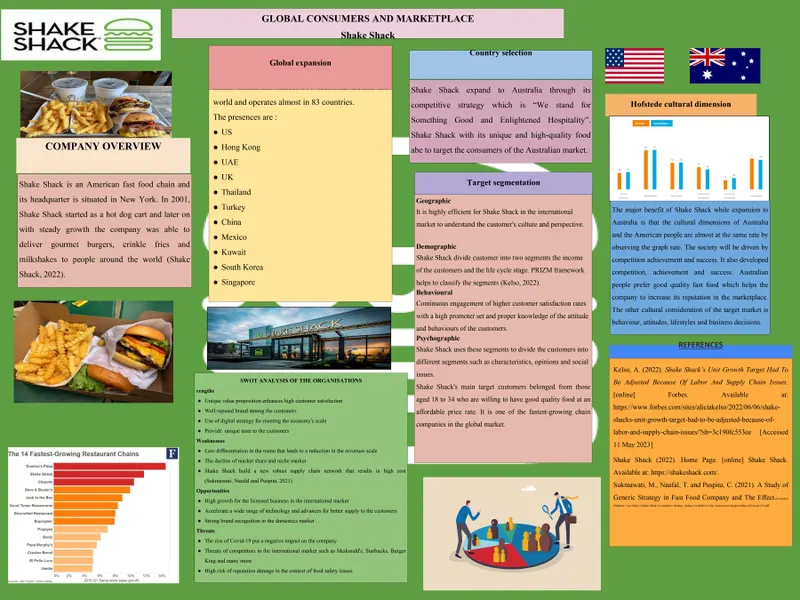
The poster below uses four panels of analysis. The company overview establishes who the firm is and where it operates. The SWOT does the internal and external position in one grid. The segmentation panel answers the "global consumers" half of the brief on four bases. Hofstede's dimensions answer the marketplace half by comparing the home and target cultures. A short conclusion and a reference list close it.
What Is Shake Shack and How Did It Grow?
Shake Shack is an American fast-food chain headquartered in New York. It began in 2001 as a hot dog cart in Madison Square Park, and the first permanent Shack opened on the same site in 2004. From there it built a menu of gourmet burgers, crinkle-cut fries and milkshakes and took it international (Shake Shack, 2022; Shake Shack Inc., 2026).
Australia is the entry market the poster assesses. Shake Shack had no presence there when the poster was written; its first Australian appearance came later, as a pop-up at the 2026 Australian Open in Melbourne (Australian Open, 2025). The poster tests the fit of the company's stated competitive position, "We stand for Something Good" and "Enlightened Hospitality", against Australian consumer culture. The proposition is quality food and service at a price above the mass-market chains, which is the segment the analysis argues an Australian entry would need to target.
How Far Has Shake Shack Expanded?
At the end of its 2021 financial year Shake Shack had 369 Shacks: 218 company-operated in the United States and 151 licensed at home and abroad (Shake Shack Inc., 2022). Four years later the system was more than 300 locations larger: over 670 system-wide at the end of the 2025 financial year, with close to 430 in 35 United States states and the District of Columbia and more than 240 international (Shake Shack Inc., 2026).
Total revenue for the 2025 financial year was 1,445.3 million dollars and system-wide sales 2,228.8 million dollars. Forty-five company-operated Shacks and forty licensed Shacks opened during the year, which tells you the growth is now running through both models at once.
The release names its international locations by city rather than by country, and it does not give a complete list. Its wording is that the over 240 international locations sit "across London, Hong Kong, Shanghai, Singapore, Mexico City, Istanbul, Dubai, Tokyo, Seoul and more" (Shake Shack Inc., 2026). Those nine cities are:
- London, United Kingdom
- Hong Kong
- Shanghai, China
- Singapore
- Mexico City, Mexico
- Istanbul, Turkey
- Dubai, United Arab Emirates
- Tokyo, Japan
- Seoul, South Korea
What Does a SWOT Analysis of Shake Shack Show?
It shows a differentiated brand with a cost problem. The strengths sit in the proposition, domestic brand recognition and digital ordering; the weaknesses sit in a narrow menu and an expensive supply chain; the opportunity is licensed growth, which delivered 40 of the 85 Shacks opened in 2025; the threats are development delays, the global chains and food-safety risk.
Strengths
- A differentiated value proposition that supports high customer satisfaction
- Strong brand recognition in the domestic market
- Digital ordering: about 43% of sales came through digital channels by mid-2022, and more than 75% counting in-store kiosks (Kelso, 2022)
Weaknesses
- Little differentiation within the menu, which limits revenue growth
- A price position above the mass-market chains, which narrows the segment the brand can reach
- A newly built supply chain network that carries a high cost (Sukmawati, Naufal and Puspita, 2021)
Opportunities
- Licensed growth at home and abroad: 40 of the 85 Shacks opened in 2025 were licensed (Shake Shack Inc., 2026)
- Further investment in technology to improve supply to customers
Threats
- Development delays in construction, permits and equipment, which lowered the 2022 target for new Shacks from 45–50 to about 40–45, and beef costs up about 20% year on year (Kelso, 2022)
- Global competitors in the same international markets, including McDonald's, Starbucks and Burger King
- Reputational damage from any food-safety incident
How Does Shake Shack Segment Its Global Customers?
The poster segments customers by geography, demographics, behaviour and psychographics, and all four bases lead to the same target: customers aged 18 to 34 who want good-quality food at a price they can justify. Each base gets a line or two on the poster; the notes below say what that line has to carry.
Geographic
Geography decides which cultures and tastes the menu has to fit. The company states its own international markets by city rather than by country, London, Hong Kong, Shanghai, Singapore, Mexico City and the rest, which is itself a geographic segmentation: each city is treated as a separate consumer market with its own tastes.
Demographic
Two demographic bases are used: household income and life-cycle stage. The poster names PRIZM as the classification behind them. PRIZM Premier, the Claritas system, sorts households into more than 68 segments using demographics, lifestage and purchase behaviour (Claritas, no date). Note the limit for a market-entry panel: PRIZM is built on United States household data, so the segments do not transfer to an Australian entry without a local equivalent.
Behavioural
Behavioural segmentation tracks what customers do rather than who they are: how often they return, how satisfied they say they are, and how many would recommend the brand. The poster treats a high proportion of promoters as the marker of the segment worth holding on to.
Psychographic
Psychographic segmentation groups customers by attitudes, opinions and the social issues they care about. That is the base the stated positioning, "We stand for Something Good", is aimed at, which makes it the easiest of the four to illustrate on a poster with one quotation from the company.
What Do Hofstede's Cultural Dimensions Say About Australia?
On The Culture Factor Group's current scores, Australia and the United States are close on five of the six dimensions, never more than six points apart. Individualism is the exception: Australia scores 73 and the United States 60. For a brand built in New York, that makes Australia a short cultural step with one adjustment to plan for.
Hofstede scores for Australia and the United States
| Point of comparison | Australia | United States | Gap (points) |
|---|---|---|---|
| Power distance | Australia 38 | United States 40 | Gap (points) 2 |
| Individualism | Australia 73 | United States 60 | Gap (points) 13 |
| Motivation towards achievement and success | Australia 61 | United States 62 | Gap (points) 1 |
| Uncertainty avoidance | Australia 51 | United States 46 | Gap (points) 5 |
| Long term orientation | Australia 56 | United States 50 | Gap (points) 6 |
| Indulgence | Australia 71 | United States 68 | Gap (points) 3 |
Taken dimension by dimension, the current scores make the case for Australia. Low power distance in both markets (38 and 40) means the informal, first-name service style Shake Shack runs in New York reads as normal rather than as rude. Near-identical scores on motivation towards achievement and success (61 and 62) mean competition, achievement and doing something visibly well are read positively in both, which is the ground a positioning such as "We stand for Something Good" stands on. Intermediate uncertainty avoidance (51 and 46) means a new brand does not have to overcome a strong preference for the familiar. High indulgence (71 and 68) matters for a product bought as a treat rather than as a staple. The individualism gap cuts the other way and is the one adaptation point: at 73 Australia is the more individualist of the two on this data, so an appeal to group belonging would carry less weight there than the same campaign does at home.
Two cautions before you reuse these numbers. The Culture Factor Group has re-scored the model, and the chart on the poster above is a screenshot of the earlier version of the same comparison tool: it gives individualism of 90 for Australia and 91 for the United States and long term orientation of 21 and 26, and it labels the third dimension "Masculinity". The other four scores have not moved. On the older numbers the two cultures look almost identical, which is how the poster argued its case; on the current ones the individualism gap appears. So name the version you used and the date you read it. And a national score describes a population, not the customers of one restaurant in one city, so a poster should also name the Australian market it means and the behaviour, attitudes, lifestyles and local business practice it expects to find there.
For a full market-entry analysis rather than a poster panel, see our global marketing strategy sample or the cross-cultural differences in business sample, which takes Hofstede's dimensions further on the 2015 edition of the scores. More samples of this kind are in our MBA assignment samples, and the service page is MBA assignment help.
Need a management poster on a different company, or the video script to go with it? Message us on WhatsApp with the brief, the panel count and the deadline.
Sources and References
- Australian Open (2025) AO launches new food and drink line-up for 2026, headlined by Shake Shack, 7 October 2025. ausopen.com. Source for the first Australian pop-up.
- Claritas (no date) PRIZM Premier. claritas.com/prizm. Source for the description of PRIZM Premier and its segment count.
- The Culture Factor Group (2026) Country comparison tool: Australia and the United States. theculturefactor.com (read 24 September 2026). Source for the six current scores compared under the Hofstede heading.
- Kelso, A. (2022) Shake Shack's unit growth target had to be adjusted because of labor and supply chain issues. Forbes, 6 June 2022. forbes.com; archived copy (read 24 September 2026). Source for the 2022 opening target and the delays behind it, the beef-cost rise and the digital share of sales.
- Shake Shack Inc. (2022) Shake Shack announces fourth quarter and fiscal year 2021 financial results, 17 February 2022. SEC EDGAR (Exhibit 99.1). Source for the 2021 year-end count of 218 company-operated and 151 licensed Shacks.
- Shake Shack Inc. (2026) Shake Shack announces fourth quarter and fiscal year 2025 financial results, 26 February 2026. SEC EDGAR (Exhibit 99.1). Source for the store count, market list, revenue, system-wide sales and 2025 openings.
- Shake Shack (2022) Home page. shakeshack.com.
- Sukmawati, M., Naufal, T. and Puspita, C. (2021) A study of generic strategy in fast food company and the effect of Covid-19 pandemic: case study of Shake Shack's competitive strategy. Proceedings of the 11th Annual International Conference on Industrial Engineering and Operations Management, Rome. ieomsociety.org (PDF).
Frequently Asked Questions
What goes on a management poster assignment?
Six panels usually: a title with your module and student number, a short company overview, one or two analytical frameworks such as SWOT or segmentation, a cultural or market-entry panel, a conclusion of two or three sentences, and a reference list. Keep each panel under about 120 words so it can be read standing up.
How many words should a poster assignment be?
Use the limit in your brief. If it sets none, work back from the panels: a marker reads a poster standing up, so about 120 words is the most one panel can hold, and four analysis panels at that ceiling come to 480 words at most before the title, conclusion and references are added.
How many Shake Shack locations are there?
Shake Shack reported more than 670 locations system-wide at the end of its 2025 financial year, of which close to 430 were in 35 United States states and the District of Columbia and more than 240 were international, including London, Hong Kong, Shanghai, Singapore, Mexico City, Istanbul, Dubai, Tokyo and Seoul.
Which frameworks suit a global consumers and marketplace poster?
SWOT for the internal and external position, segmentation on geographic, demographic, behavioural and psychographic bases for the consumer half, and Hofstede's cultural dimensions to compare the home and target markets. PESTEL and Porter's Five Forces also fit, but three frameworks is usually the most a poster can carry.
Do you write poster assignments and the video script together?
Yes. Many poster briefs ask for a recorded presentation as well, so a script written to the poster panels is part of the same job. Send us the brief, the word count and the deadline on WhatsApp and we will tell you what we can do.