How to Study for University Exams: A Four-Week Revision Plan
A four-week revision plan for university exams, each step tied to a named study: test yourself instead of re-reading, space the reviews so the gaps grow with the time left, work past papers under the clock, and keep regular sleep through the whole month rather than only the night before. The day before is for logistics, not learning.

This guide sets out how to study for university exams over the four weeks before a written paper. It is for undergraduate and masters students, and it is arranged in the order you need it: work out what is examinable, count the hours you have, revise by testing yourself and spacing the reviews, keep regular sleep through the whole month, and treat the day before as logistics rather than learning. Each step names the study behind it, and the techniques the research does not support, re-reading and highlighting, are left out.
If you want study techniques for the whole term rather than for an exam period, read our companion guide to the best study techniques for university students. This page takes the exam-specific half: the revision period, past papers and the last week.
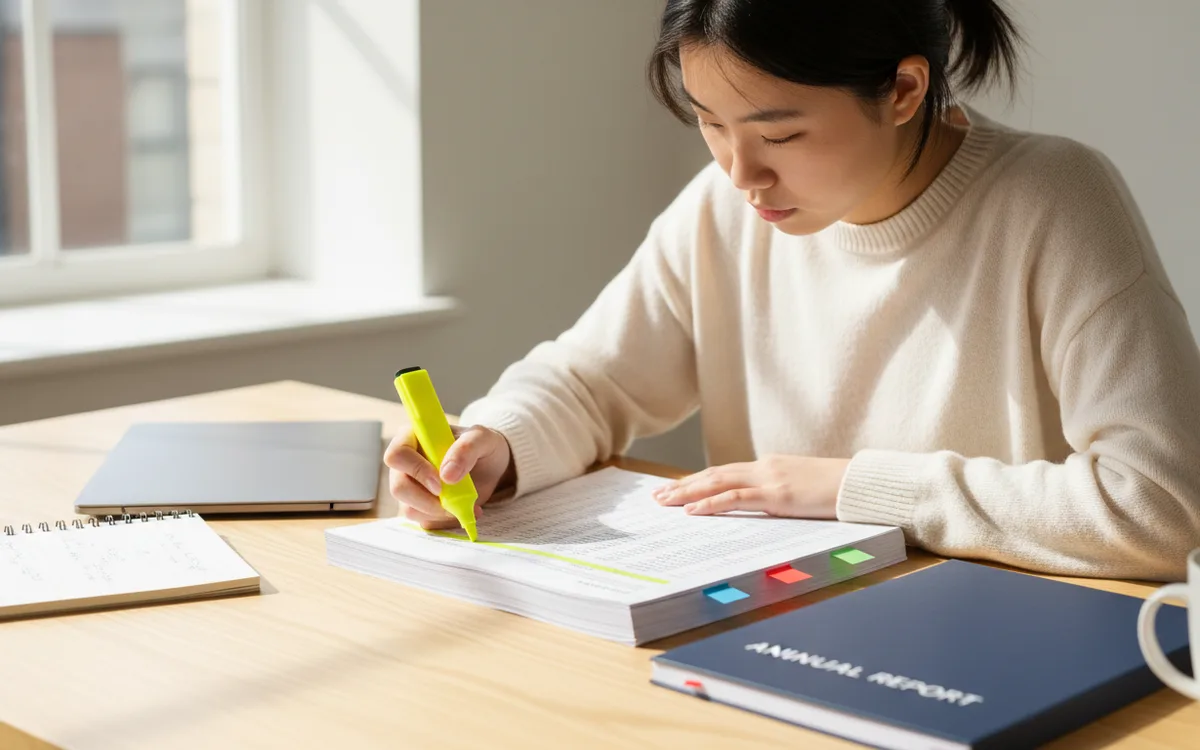
The evidence base is short. Dunlosky and colleagues reviewed ten common study techniques for Psychological Science in the Public Interest and rated only two as high utility: practice testing and distributed practice, because they help learners of different ages and abilities across many kinds of test. Re-reading and highlighting, the two techniques most students report using, were rated low. Everything below follows from that.
How Do You Plan Revision for a University Exam?
Start with the syllabus and the exam format, because they decide what is examinable and how it will be asked. Then count the hours you actually have free in each week and divide them between papers by the marks available and by how far behind you are. The hardest topics go first, while there is still time for a second pass.
1. Know Your Syllabus and Course Material
Before you revise anything, read the syllabus and check that you have material for every topic on it. You are looking for two things: topics you have no notes for, and topics that carry more marks than you have given them time. Both are easier to fix four weeks out than four days out. Gather the lecture slides, your notes, the reading list and any worked examples in one place, so that a revision session starts with reading rather than with searching.
2. Count the Hours You Actually Have
Divide the time you have between the papers you sit, topic by topic where you can. Count the hours free in a week, not the hours in the week. A timetable that assumes ten clear hours a day collapses on the second day and takes your confidence with it, whereas three or four realistic sessions a day survives a bad morning. Weight each paper by the marks available and by how far behind you are.
Then start earlier than you want to. Most of the pressure students describe in exam season comes from reading that was never done, not from the revision itself, and a topic read for the first time in the last week gets no second pass at all.
3. Understand the Exam Format
Find out what the paper looks like before you decide how to revise. Preparation for a multiple-choice paper and preparation for an essay paper are different activities, and the format also tells you how much of the material is examinable at all. Check the number of questions, how much choice you have, how long you have and whether anything is open book.
- For a multiple-choice paper, work on precise definitions, key terms and the distinctions between similar concepts, because that is what the options test.
- For a written paper, work on structure and explanation: you are being marked on an argument, so practise producing one under time pressure.
Which Revision Techniques Actually Work?
Testing yourself and spacing the reviews. Both were rated high utility in the Dunlosky review, and both make you produce the answer rather than recognise it, which is what an exam asks of you. Re-reading and highlighting feel productive and were rated low. Past papers are the exam-shaped version of the same testing effect, so they come last and get the final fortnight.
4. Test Yourself Instead of Re-Reading
Active recall means closing the book and producing the answer from memory. Roediger and Karpicke had students read prose passages and then either re-read them or take free-recall tests, and tested everyone again after five minutes, two days or a week. At five minutes the re-readers did better. At two days and at a week the tested students remembered substantially more, even though re-reading had left students more confident about what they knew. That last finding is why the method feels wrong while you use it: the confidence you get from re-reading is real and the memory is not.
Three ways to use it:
- Read a chapter once, close it, and write down everything you can remember. Then open it and mark what you missed. The gap is your revision list for that topic.
- Explain the concept in plain language, as if to someone who has never met it, and note the point at which you reach for jargon to cover a gap. Dunlosky and colleagues rate self-explanation, the nearest technique in their review, as moderate utility: it helps, and it has been tested less than practice testing, so use it to find the gaps and use testing to close them.
- If the material has a shape, redraw it from memory: a flowchart, a labelled process, a concept map. Copying the diagram out of the textbook is re-reading with a pen.
5. Prioritise the Hardest Topics First
Start with the topics you find hardest, while there is still time to come back to them. Difficult material needs more than one pass, and the spacing research below says the passes need days between them, which is exactly what the last week does not have. Identify the weak topics honestly, from past marks or from the recall gaps in tip 4, break each one into parts and revise the parts, and give them the first slots in the plan rather than the last.
6. Space the Reviews so the Gaps Grow
Forgetting after one read is normal; the timing of the second read matters more than the number of hours. Cepeda and colleagues pooled 839 comparisons from 317 experiments and found that the best gap between two study sessions depends on how far away the test is: the longer the delay to the test, the longer the gap should be. Their 2008 follow-up, with more than 1,350 people and test delays of up to a year, put a number on it. For a test one week away the best gap was about 20 to 40 per cent of that week, one to three days; for longer delays the best gap was longer in days but a smaller share of the delay. Neither paper tests a four-week revision period, so the rhythm below is our reading of them, not a figure from them.
- Review a topic one or two days after you first read it, again about a week later, and once more in the final fortnight. Stop when you can produce it without prompting.
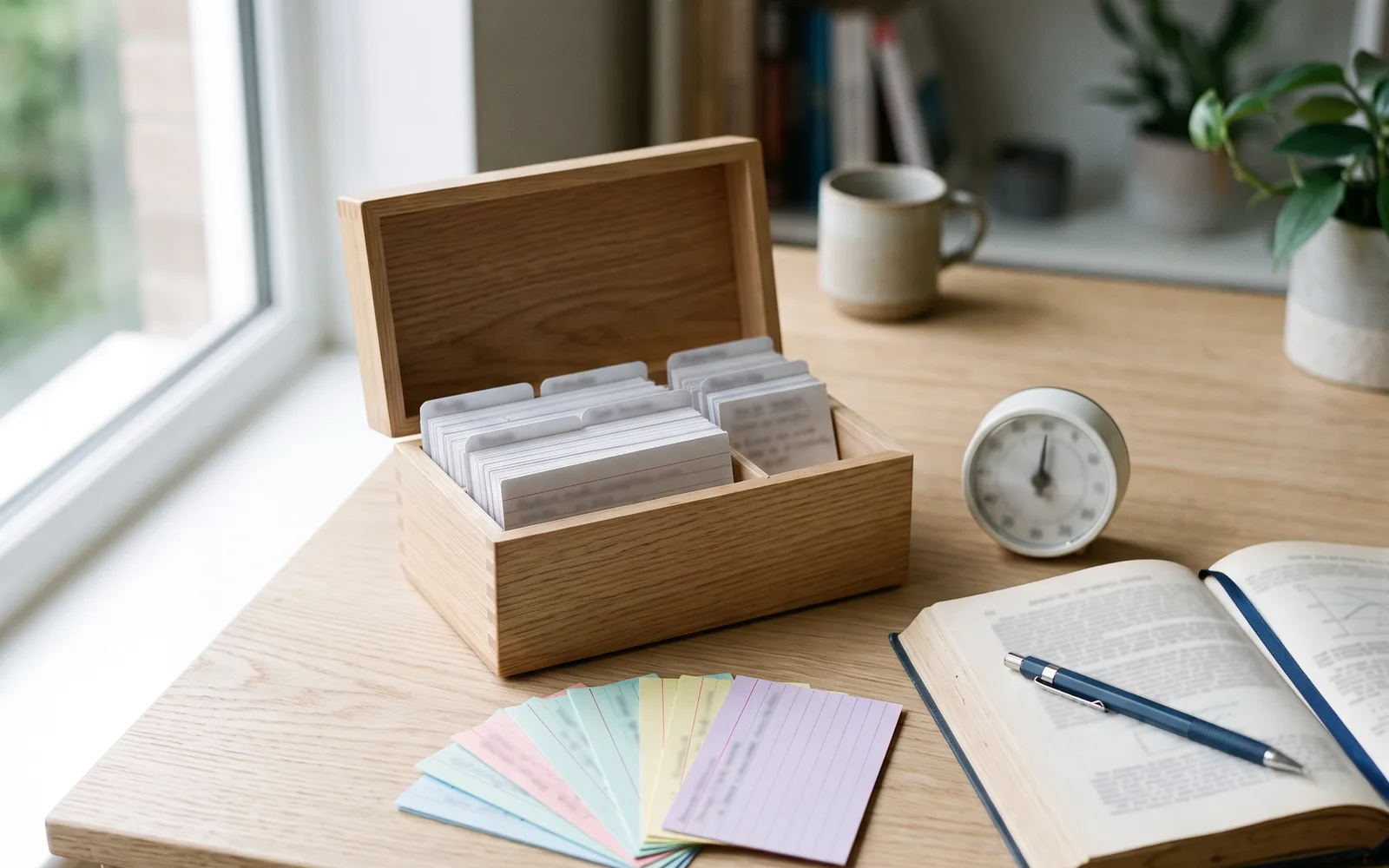
- Flashcard software such as Anki schedules the intervals for you. A list of questions on paper and a calendar do the same job with no software.
Once you have read everything once, the rest of the period is testing and practice rather than reading.
7. Work Past Papers Under Time
Past papers are the exam-shaped form of practice testing, and they are what to use if time has already run short. They show which topics recur, how the questions are phrased and how the marks are split, so you can revise a small number of topics properly and skim the rest.
- Work through two or three papers before you plan the last fortnight, and mark the topics that appear every year.
- Then write at least one full answer under the exam's time limit with no notes. Knowing the material and producing it in ninety minutes are different skills, and only the second one is marked.
What Does a Four-Week Revision Plan Look Like?
Week one: map the syllabus, the format and your free hours, and start the hardest topics. Weeks one to three: a first read of every topic, each tested from memory a day or two later. From week two: a second review of each topic about a week on. Weeks three and four: timed past papers. Regular sleep throughout, and nothing new in the last two days.
A four-week revision plan for a written exam
-
Map the syllabus, the format and your free hours
Week 1
One session. Topics with no notes and papers worth the most marks get the hours.
-
First read of every topic, hardest first
Weeks 1–3
Read once, close the book, write what you can. The gaps are the revision list.
-
First self-test, one to two days after each read
Weeks 1–3
Testing beats a second read at this gap (Roediger and Karpicke, 2006).
-
Second review, about a week later
Weeks 2–4
The best gap grows with the time to the exam (Cepeda et al., 2006, 2008).
-
Timed past papers
Weeks 3–4
Two or three papers to find the recurring topics, then full answers under the clock.
-
Regular sleep, all four weeks
Weeks 1–4
Sleep in the week and month before a test predicted grades; the night before did not (Okano et al., 2019).
-
Last two days: known material only, pack, sleep
Week 4
Timeline data
| Phase | Start (week) | End (week) |
|---|---|---|
| Map the syllabus, the format and your free hours | 1 | 1 |
| First read of every topic, hardest first | 1 | 3 |
| First self-test, one to two days after each read | 1 | 3 |
| Second review, about a week later | 2 | 4 |
| Timed past papers | 3 | 4 |
| Regular sleep, all four weeks | 1 | 4 |
| Last two days: known material only, pack, sleep | 4 | 4 |
The plan is illustrative. Scale it to the weeks you have and to the number of papers you sit. The phases overlap on purpose, because the second review of one topic lands while the first read of the next is still going, and because the sleep phase is the whole month rather than the last night. If you have two weeks rather than four, keep the order and halve the gaps. If you have one, go straight to past papers (tip 7) and test yourself on the topics that recur.
How Do You Stay Focused and Well During Exam Season?
Treat sleep as part of the plan rather than what is left over, because it is the one wellbeing factor with a measured link to grades. Then remove the distractions you know about before the session starts, work in short blocks with breaks on a schedule, and give each day a fixed end so the plan survives a bad morning.
8. Sleep for the Month, Not the Night
Okano and colleagues gave activity trackers to 100 students on an introductory chemistry course, 88 of whom finished, and matched their sleep against quiz and exam marks through the term. Better, longer and more consistent sleep went with better grades, and the sleep measures together accounted for nearly a quarter of the variance in performance. Sleep on the single night before a test made no difference on its own. Sleep over the week and the month before it did.
For revision that means one decision, made early: keep the same bedtime and the same waking time through the whole revision period, and treat an all-nighter as spending the sleep that was actually helping. The study is one course at one university and it is correlational, so it cannot show that sleep caused the grades; it is a strong reason to protect the pattern rather than a proof.
9. Take Breaks on a Schedule
Long unbroken sessions produce less than short ones with breaks. The simplest version is the Pomodoro rhythm: about 25 minutes of work, five to ten minutes away from the desk, and a longer break after four cycles. The one trial that compared fixed breaks with breaks students chose for themselves is summarised in our study techniques guide; the short version is that breaks on a schedule left students less tired and no less productive.
Two habits make the blocks work. Put the phone in another room before you start, because the cost is the checking rather than the notification. And set a fixed end to the day: "two modules and then stop" is a plan you can keep, and "study until I feel done" is not.
What Should You Do the Day Before an Exam?
Nothing new. Read over the material you know best, confirm the time and the room, and put your ID, pens, calculator and water by the door. Go to bed at your usual time rather than early or late: the sleep that will help you tomorrow was banked over the last month, and one long night now will not replace it.
10. Keep a One-Page Tracker per Module
Keep a single page per module with the topics listed down the side and a tick for each pass you have made through them: first read, first self-test, second review, past paper. It takes a minute a day to maintain, it tells you where the next session goes, and it is a better guide than the feeling of how well revision is going, which the re-reading study in tip 4 shows is exactly the feeling you cannot trust. In the last week the page is also what stops you re-revising the comfortable topics you already know.
Revising for university exams is demanding, and the plan above is meant to make it orderly rather than easy. Testing yourself, spacing the reviews and working past papers under time are the parts with the research behind them, so give them the hours first. Then keep what works for you and drop the rest, because a plan you follow beats a better plan you abandon.
More study and writing guides are in our education samples, including how to select a topic for your dissertation and dissertation writing tips. If it is the coursework rather than the exam that is due, see essay writing help.
Revising for exams and a piece of coursework due in the same week? Message us on WhatsApp with the brief and the deadline and we will tell you what we can do.
Sources
- Cepeda, N. J., Pashler, H., Vul, E., Wixted, J. T. and Rohrer, D. (2006). Distributed practice in verbal recall tasks: a review and quantitative synthesis. Psychological Bulletin, 132(3), 354–380. https://doi.org/10.1037/0033-2909.132.3.354
- Cepeda, N. J., Vul, E., Rohrer, D., Wixted, J. T. and Pashler, H. (2008). Spacing effects in learning: a temporal ridgeline of optimal retention. Psychological Science, 19(11), 1095–1102. https://doi.org/10.1111/j.1467-9280.2008.02209.x
- Dunlosky, J., Rawson, K. A., Marsh, E. J., Nathan, M. J. and Willingham, D. T. (2013). Improving students' learning with effective learning techniques: promising directions from cognitive and educational psychology. Psychological Science in the Public Interest, 14(1), 4–58. https://doi.org/10.1177/1529100612453266
- Okano, K., Kaczmarzyk, J. R., Dave, N., Gabrieli, J. D. E. and Grossman, J. C. (2019). Sleep quality, duration, and consistency are associated with better academic performance in college students. npj Science of Learning, 4, 16. https://doi.org/10.1038/s41539-019-0055-z
- Roediger, H. L. and Karpicke, J. D. (2006). Test-enhanced learning: taking memory tests improves long-term retention. Psychological Science, 17(3), 249–255. https://doi.org/10.1111/j.1467-9280.2006.01693.x
Frequently Asked Questions
How early should I start studying for my university exams?
Make study part of the weekly routine, then start dedicated revision four to six weeks before the first paper. That leaves room for a first pass, a self-test a day or two later, a second review a week on and past papers in the last fortnight, instead of trying to do all four in the final week, which is where most marks are lost.
What are the best study techniques for retaining information?
Practice testing and spaced practice. Dunlosky and colleagues reviewed ten common techniques in 2013 and rated only those two as high utility, because they work across ages, subjects and kinds of test. Re-reading and highlighting, the two most students rely on, were rated low. Explaining a topic in your own words was rated moderate: useful for finding gaps, less tested than self-testing.
How can I stay focused and avoid distractions while studying?
Pick one quiet place, put the phone in another room before you start, and work in timed blocks with breaks on a schedule rather than when you feel like one. Give each day a fixed end. Deciding whether to check the phone is the expensive part, so make that decision once in the morning instead of every ten minutes.
What should I do the night before an exam?
Read over material you already know, confirm the time and the room, and pack your ID, pens, calculator and water. Then go to bed at your normal time. In the 2019 tracker study by Okano and colleagues the night before a test did not predict the grade, but the week and the month before did, so the sleep decision that matters was made earlier.
How do I revise when I have very little time left?
Work from past papers. They show which topics recur and how questions are phrased, so you can revise a few topics in depth and skim the rest. Test yourself on each one from memory before you re-read it, then write at least one full answer under the exam's time limit, because producing an answer in ninety minutes is the skill being marked.