AI in Supply Chain Management: Poster-Making Assignment Sample
A one-poster undergraduate business assignment on artificial intelligence in international supply chain management. It argues four benefits and works through three applications with a named system for each: route optimisation at UPS, predictive vehicle maintenance with Uptake, and trailer loading and unloading, where DHL's robot is the documented case. A 2026 update covers where supply chain AI is heading.
This is a poster-making assignment on the effect of artificial intelligence in international supply chain management, written at undergraduate business level. A poster brief has to carry a whole argument on one page: an abstract, a short introduction, the benefits of AI for supply chain and logistics, worked examples of where AI is already in use, and a conclusion. The cited research runs to 2022, and a 2026 update has been added at the foot. What earns this poster its credit is that it names a system for each application it claims, ORION for routing, Uptake for vehicle health and Amazon for loading, rather than listing capabilities. The sections below add the published result behind each, with DHL's Stretch robot as the documented loading case.
For a longer piece on the same subject, read our case study on Samsung's supply chain management. The service page is MBA and management assignment help, and there are more business assignment samples in the archive.
Abstract
This poster sets out how artificial intelligence is applied in supply chain management at the international level. It explains what the technology does in a logistics setting, argues four benefits for the industry, and works through three applications already in commercial use: route optimisation, predictive vehicle maintenance, and loading and unloading. The conclusion states what the evidence supports and what it does not.
Also read our poster making assignment help for a fast food restaurant and this poster assignment on global consumers and the marketplace.
Poster Making Assignment: The Effect of AI in International Supply Chain Management
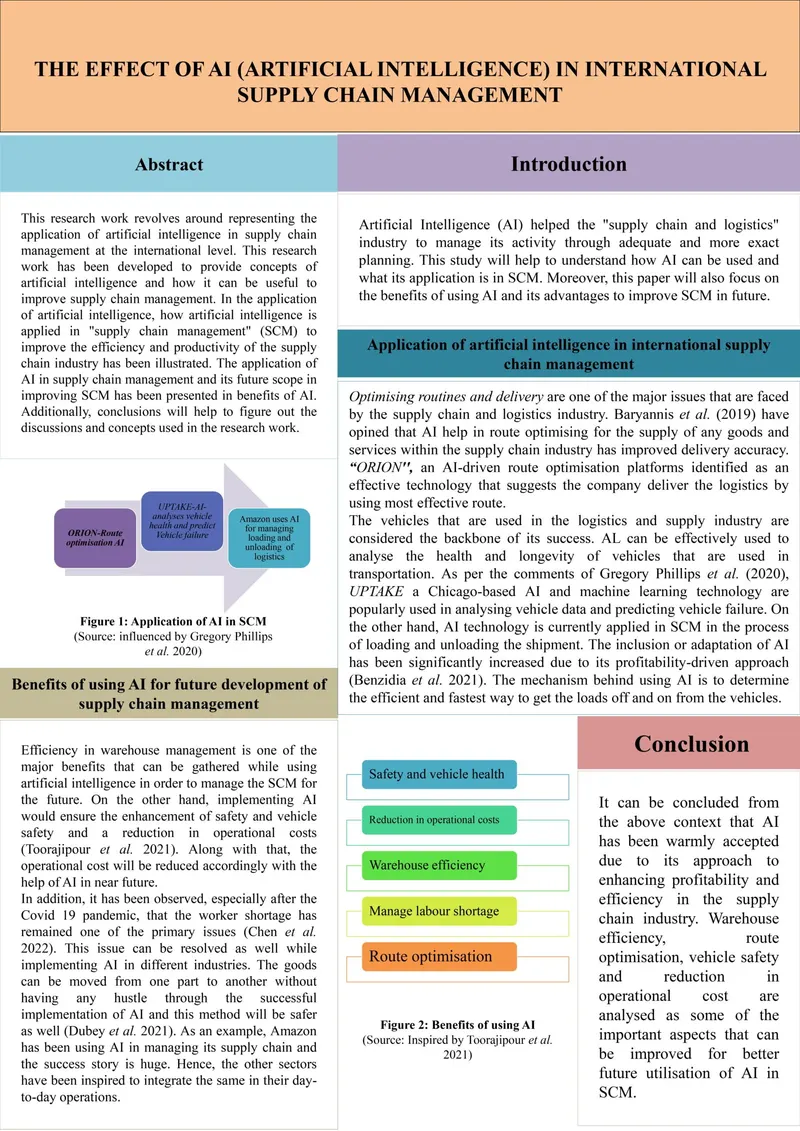
The poster as submitted is shown below; the sections that follow set out its argument with the sources in full.
Introduction
Artificial intelligence has helped the supply chain and logistics industry plan its activity more precisely. This poster sets out how AI is used in the industry, which applications are already running commercially, and what the benefits are for the operators who adopt it. The claims are kept to what the cited literature supports, which is why the poster argues improvement rather than transformation.
What Are the Benefits of AI in Supply Chain Management?
Four benefits are argued on this poster: better warehouse throughput, lower operating cost, safer vehicle and driver operations, and cover for work that is hard to staff. The evidence is uneven. Cost and warehouse throughput have published figures (UPS and Amazon); staffing has a shortage count from the American Trucking Associations; safety rests on a named example.
Warehouse efficiency is the benefit the poster lists first. Scheduling and picking software decides what is moved, when, and by whom, and it does so continuously rather than shift by shift. The poster's benefits figure is drawn from Toorajipour et al. (2021), a systematic review that maps which AI techniques are already used in supply chain management and which have potential, across four fields: logistics, marketing, supply chain and production. The review is a map of where AI has been applied, not a measurement of the gains; the figure comes from Amazon, the warehouse operator the poster names. Amazon reports that Sequoia, a robotic storage system it launched at one of its Houston fulfilment centres in October 2023, lets it identify and store incoming inventory "up to 75% faster than we can today" and cuts the time to process an order by up to 25% (Amazon, 2023).
Operating cost falls for a related reason. Fewer empty miles, fewer re-picks and fewer unplanned stops each remove a cost from the same volume of work. The clearest published figure is UPS's: ORION, first deployed in 2012, "has saved UPS about 100 million miles and 10 million gallons of fuel per year" (UPS, 2020).
Safety and vehicle health is the third claim, and it is the one to state carefully. A vehicle serviced before a predicted failure does not stop on a motorway, and a robot that unloads a trailer takes the lifting out of a hot, repetitive job; DHL gave "safety concerns" as one of its two reasons for automating unloading (DHL Supply Chain, 2023). The claim is therefore a mechanism, not a measured fall in injuries: no source cited here reports one.
Cover for work that is hard to staff is the fourth claim, and it explains the timing of adoption rather than its size. The American Trucking Associations put the US driver shortage at 80,000 in October 2021, "an all-time high for the industry", and listed "pandemic-related challenges from early retirements, closed driving schools and DMVs" among the pressures behind it (ATA, 2021). DHL gave the continuing shortage of warehouse staff as the second reason for its unloading robots (DHL Supply Chain, 2023). When drivers and handlers cannot be hired, the repetitive tasks are the ones automated first.
How Is AI Applied in International Supply Chain Management?
The poster works through three applications, each with a named system. Route optimisation software chooses the delivery sequence and the road route (UPS's ORION). Predictive maintenance reads vehicle fault data and flags a likely failure before the breakdown (Uptake). Loading systems set the order goods come on and off a vehicle; the poster names Amazon, and DHL has since documented one.
The three applications on the poster, with the system named and the published result
| Point of comparison | Route optimisation | Predictive vehicle maintenance | Loading and unloading |
|---|---|---|---|
| What the system decides | Route optimisation The order of a driver's stops and the road route between them, updated during the day | Predictive vehicle maintenance Which vehicle is drifting towards a failure, so it is serviced in a planned slot | Loading and unloading The order cartons come on and off a trailer, given drop sequence, weight and stackability |
| Named system | Route optimisation UPS ORION, first deployed in 2012 | Predictive vehicle maintenance Uptake, fleet analytics | Loading and unloading Amazon on the poster; documented case: Boston Dynamics Stretch at DHL Supply Chain |
| Documented result | Route optimisation About 100 million miles and 10 million gallons of fuel saved per year | Predictive vehicle maintenance Breakdowns down 20% in the first 100 days at one multinational CNG fleet | Loading and unloading Case-unload speed above the manual approach in every environment tested |
| Source and date | Route optimisation UPS press release, 29 January 2020 | Predictive vehicle maintenance Uptake, 6 May 2022 | Loading and unloading DHL Supply Chain press release, 31 January 2023 |
Route optimisation is the first. ORION, the system UPS uses to order a driver's stops and pick the road route between them, "determines the optimal order for local UPS package car drivers to make deliveries and pickups" (UPS, 2018). It was first deployed in 2012 and by 2020 ran on more than 66,000 routes in the United States, Canada and Europe, serving drivers who complete an average of 135 stops a day. In January 2020 UPS announced Dynamic Optimization, which "will update routes throughout the day, based on traffic, delivery and pickup commitments" (UPS, 2020), the re-planning that a printed route sheet cannot do.
Predictive maintenance is the second. Vehicles are the backbone of a logistics operation, and a breakdown costs more than the repair, because it costs the route. Uptake, the Chicago-based analytics company the poster names, reads a fleet's "signal and fault readings, work order history, component-level survivability curves" and alerts the workshop to the vehicle that is drifting towards a failure, so it is booked into a planned slot instead of stopping on the road. Its published fleet result: in the first 100 days with one multinational food and beverage CNG fleet, "breakdowns were reduced by 20%" (Uptake, 2022).
Loading and unloading is the third: the order in which cartons go on and come off a vehicle, set by the drop sequence, the weight distribution and what is stackable. The poster names Amazon. The best-documented case came later. On 31 January 2023 DHL Supply Chain "became the first company to achieve commercial application of Boston Dynamics' Stretch robot" for unloading cartons from trailers and containers, a year after a $15 million investment in Boston Dynamics robots, and reported that "in all tested environments, the case-unload speed exceeded the manual approach" (DHL Supply Chain, 2023).
What Is Changing in Supply Chain AI in 2026?
The shift since this poster was written is from single-task tools to systems that act. Gartner's list of top supply chain technology trends for 2026 is led by agentic AI, collaborative multiagent systems and physical AI, alongside polyfunctional robots, intelligent simulation, domain-specific language models, product provenance and decision governance (Gartner, 2026), as reported in full by Inside Logistics (2026).
Supply chain AI on this poster (sources to 2022) against Gartner's 2026 trends
| Point of comparison | Single-task tools (this poster, sources to 2022) | Systems that act (Gartner, 2026) |
|---|---|---|
| Autonomy and agency | Single-task tools (this poster, sources to 2022) Route optimisation, predictive maintenance and loading, each replacing one judgement a person used to make | Systems that act (Gartner, 2026) Agentic AI, collaborative multiagent systems, physical AI, polyfunctional robots |
| Specialisation and intelligence | Single-task tools (this poster, sources to 2022) Models trained on one operator's own fault history or routes | Systems that act (Gartner, 2026) Intelligent simulation, domain-specific language models |
| Trust and governance | Single-task tools (this poster, sources to 2022) Not addressed: the poster has no line on who signs off an automated decision | Systems that act (Gartner, 2026) Product provenance, decision governance |
Gartner groups those trends under three headings: autonomy and agency, specialisation and intelligence, and trust and governance. The third is the one this poster does not reach, and it matters most once a system places an order or reroutes a shipment on its own: the question then is who signed it off and how the decision is logged, not how capable the model is.
Conclusion
The evidence supports a clear but bounded claim. AI has been adopted quickly in supply chain and logistics because it raises throughput and takes cost out of the same volume of work, and because it covers tasks that are hard to staff. Warehouse throughput, operating cost, vehicle and driver safety, and cover for work that is hard to staff are the four benefits this poster found strongest support for. What the cited literature does not show is a transformed industry: the gains are real, and the documented ones come from operators large enough to fund the data work behind them.
Need a similar poster or a supply-chain case study? Message us on WhatsApp with your brief, the poster size and your deadline.
Sources
- Amazon (2023). Amazon announces new fulfillment center robots, Sequoia and Digit, 18 October 2023. https://www.aboutamazon.com/news/operations/amazon-introduces-new-robotics-solutions
- American Trucking Associations (2021). ATA chief economist pegs driver shortage at historic high, 25 October 2021. https://www.trucking.org/news-insights/ata-chief-economist-pegs-driver-shortage-historic-high
- DHL Supply Chain (2023). DHL Supply Chain achieves first commercial deployment of Boston Dynamics' Stretch robot to unload trailers and containers in the warehouse. Press release, 31 January 2023, reprinted by DC Velocity. https://www.dcvelocity.com/articles/56491-dhl-supply-chain-achieves-first-commercial-deployment-of-boston-dynamics-stretch-robot
- Gartner (2026). Gartner identifies top supply chain technology trends for 2026. https://www.gartner.com/en/newsroom/press-releases/2026-06-30-gartner-identifies-top-supply-chain-technology-trends-for-2026
- Inside Logistics (2026). Gartner identifies agentic AI, physical AI among top supply chain technology trends for 2026, 2 July 2026. https://www.insidelogistics.ca/artificial-intelligence-ai/gartner-identifies-agentic-ai-physical-ai-among-top-supply-chain-technology-trends-for-2026/
- Toorajipour, R., Sohrabpour, V., Nazarpour, A., Oghazi, P. and Fischl, M. (2021). Artificial intelligence in supply chain management: a systematic literature review. Journal of Business Research, 122, 502–517. https://doi.org/10.1016/j.jbusres.2020.09.009
- Uptake (2022). How we measure the value of predictive maintenance for trucking fleets, 6 May 2022. https://uptake.com/blog/how-we-measure-the-value-of-predictive-maintenance-for-truck-fleets/
- UPS (2018). UPS deploys purpose-built navigation for UPS service personnel, 4 December 2018. GlobeNewswire. https://www.globenewswire.com/news-release/2018/12/04/1661762/0/en/UPS-Deploys-Purpose-Built-Navigation-For-UPS-Service-Personnel.html
- UPS (2020). UPS to enhance ORION with continuous delivery route optimization, 29 January 2020. GlobeNewswire. https://www.globenewswire.com/news-release/2020/01/29/1977072/0/en/UPS-To-Enhance-Orion-With-Continuous-Delivery-Route-Optimization.html
Related samples: Samsung supply chain management, artificial intelligence in human resource management, and smart city transportation.
Frequently Asked Questions
How is AI used in supply chain management?
This poster gives three uses. UPS's ORION orders a driver's stops and updates the route during the day as traffic and pickups change. Uptake reads a fleet's fault data and warns which vehicle to service before it fails. Loading systems set the order cartons come on and off a trailer, and since 2023 DHL has unloaded trailers with Boston Dynamics' Stretch robot.
What are the benefits of AI in supply chain management?
Better warehouse throughput, lower operating cost, safer vehicle and driver operations, and cover for jobs that cannot be staffed. Of the four, cost has the firmest published figure: UPS credits ORION with about 100 million miles and 10 million gallons of fuel saved a year. Staffing explains why adoption sped up after 2020, when the US driver shortage reached a record 80,000.
What is a poster-making assignment?
A single page that has to carry a whole argument. The example on this page runs an abstract, a short introduction, the benefits of AI for supply chain and logistics, three applications already in commercial use, and a conclusion, with the sources listed in full below the poster.