
Example of Research Proposal: Impact of Drug Exposure on Self-Medication Among Healthcare Professionals
This page gives you a complete research proposal on the impact of drug exposure on self-medication among healthcare professionals. It runs through the abstract, background, rationale, theory, aim and objectives, literature review, methodology, ethics, reliability and dissemination, with a full reference list, so you can see how each section is written and ordered.
This is a complete research proposal on the impact of drug exposure on self-medication among healthcare professionals, written by our team as a sample for students planning a healthcare dissertation or a research methods assignment. It follows the order most universities ask for: abstract, background, rationale, theory, aim and objectives, literature review, methodology, ethics, reliability and validity, dissemination and references. The studies it reviews were published between 2018 and 2022; the antimicrobial-resistance and spending figures come from WHO and ONS releases in 2026.
What Is a Research Proposal, and How Do You Use This Example?
A research proposal is the document you write before a dissertation or research project to show what you intend to study, why the question matters, what has already been found and how you will go about answering it. A supervisor or ethics board reads it before the study is approved, so it has to make the method, the timescale and the ethics explicit.
Read this one as a structure, not as a topic. The subject is self-medication in healthcare, but the order of the sections, the way the aim turns into objectives and then into research questions, and the way every methodological choice is justified will transfer to any subject. More samples in this field sit in our healthcare assignment samples, among them a nursing traumatic brain injury case study, and the proposal stage of a longer project is covered on our thesis and dissertation help page.
What Should a Research Proposal Include?
Most universities ask for the same sections: an abstract, background, a rationale, the theory you are building on, your aim, objectives and research questions, a literature review, your methodology, ethics, reliability and validity, and a reference list. This example contains all of them, numbered in the order they appear below.
- Abstract: what the study is about and how it will be done, in one paragraph.
- Background and rationale: what is already known, and why the study is worth doing now.
- Theoretical underpinning: the theory the argument rests on. Here it is Khantzian's self-medication theory.
- Aim, objectives and research questions: one aim, a short numbered list of objectives, and the questions the data has to answer.
- Literature review: what other researchers found, and the gap your study fills.
- Methodology: philosophy, approach, design, data collection and data analysis, each justified.
- Ethics, reliability and validity: how the work stays within the rules and why the findings can be trusted.
- Reference list: every source cited, in your department's style.
Length is set by your university's brief, so check it before you plan. The proposal itself runs to roughly 4,500 words excluding the reference list and our own commentary between the sections, because it carries a full literature review as well as a methodology chapter. If your brief asks only for a proposal up to the methodology, yours will be much shorter. Writing on a social science or healthcare topic is covered on our humanities and social science assignment help page.
Research Proposal Example: Impact of Drug Exposure on Self-Medication Among Healthcare Professionals
The proposal itself starts here. It is reproduced in full, in its original numbered sections, so you can see how each part follows from the one before it.
Abstract
The study will focus on the area of self-medication that is mostly prevalent among various base level healthcare associates. It would have the aim of evaluating the significance of medicine related knowledge and drug exposure upon self-medication strategy. This chapter would be focused to highlight the key issues of self-medication along with the impact of knowledge treatment on this particular matter. The conventional practice of self-medication in various stages of life among people will be highlighted. Khantzian's self-medication hypothesis will be used to treat the practice as purposeful behaviour with a cause that can be studied, rather than as random misuse. In this research suitable methods would be selected to justify the intention of the paper. Interpretivism philosophy, inductive approach and exploratory design will be selected in this research to collect data and interpret. Secondary qualitative data sources will be suitable for this research where thematic analysis can interpret the identified patterns. Published studies of healthcare professionals and health-science students in several countries will be reviewed and their findings drawn together under four themes. The review is expected to show that self-medication is common in this group, that its harms run from side effects to antimicrobial resistance, and that it also has a place in treating minor illness without a consultation.
Study Schedule
The schedule above sets out the plan the researcher will follow, stage by stage, from topic selection in week 1 to submission in week 14. It is included because a proposal is judged partly on whether the timescale is credible for the method chosen: a secondary review can be designed, read and analysed in this time, which is why the conclusion rules primary collection out.
Study schedule from topic selection to submission
-
Topic selection
Weeks 1–2
-
Designing the study and selecting the method
Weeks 1–5
-
Literature reviewing
Weeks 1–5
-
Making strategies for research
Weeks 3–8
-
Collecting data
Weeks 6–12
Secondary sources only, so collection is reading and extraction.
-
Results and analysis
Weeks 6–14
Thematic analysis, four themes.
-
Conclusion and recommendation
Weeks 13–14
-
Submission of project
Weeks 13–14
Timeline data
| Phase | Start (week) | End (week) |
|---|---|---|
| Topic selection | 1 | 2 |
| Designing the study and selecting the method | 1 | 5 |
| Literature reviewing | 1 | 5 |
| Making strategies for research | 3 | 8 |
| Collecting data | 6 | 12 |
| Results and analysis | 6 | 14 |
| Conclusion and recommendation | 13 | 14 |
| Submission of project | 13 | 14 |
What Is Already Known About Self-Medication Among Healthcare Professionals?
That it is common, that it is not new, and that access is the strongest driver. The background section below sets out what the practice covers, how common it is among healthcare workers before and during the pandemic, the part over-the-counter medicines play in it, and the risk the literature keeps returning to: unsupervised use of antibiotics and multiple drugs, and the resistance that follows.
1. Background of the Study
Self-medication is the use of a medicine without a prescription or a consultation: an over-the-counter product bought on one's own judgement, a medicine taken on the advice of a pharmacist, friend or relative, or what is left of an earlier course. It is not confined to people without medical training. This proposal studies the practice among healthcare professionals, the group with the most knowledge of the medicines involved and the readiest access to them, and asks what that knowledge does to the behaviour.
Where over-the-counter medicines are sold, the practice is close to universal. Tesfamariam et al. (2019) surveyed 609 customers at pharmacy outlets in Asmara, Eritrea, and found that 93.7% had self-medicated with over-the-counter drugs and that 81.8% of those had done so in a way the authors classed as risky; customers with below-average knowledge of the drugs were more likely to be in the risky group. Pain is the usual reason. Doomra and Goyal (2020) describe non-steroidal anti-inflammatory drugs as the class most often taken for acute and chronic pain without a physician's advice, because they are easy to buy, and note that regular unsupervised use carries a risk of gastrointestinal bleeding and perforation that varies with the drug and the dose.
Exposure to the wrong drugs can cause a critical health condition, and for that reason this study will focus on the part treatment knowledge plays in self-medication among healthcare professionals. Knowledge does not by itself prevent the practice. Alrabiah et al. (2022) surveyed 550 health-science students in Riyadh and found that 56.0% of those with acne had self-medicated for it, most often with antibiotics, while about 60% of the medical students among them had adequate knowledge of acne treatment. Self-medication has negative effects that can surface later, and resistance to several drugs at once is a recognised consequence of taking unprescribed medicines in combination.
Among healthcare workers the practice rose sharply under the pressure of the pandemic. Onchonga et al. (2020) surveyed 379 healthcare workers in Kenya and found that the prevalence of self-medication rose from 36.2% before the Covid-19 outbreak to 60.4% during it. Okoye et al. (2022) surveyed 669 healthcare professionals at three tertiary hospitals in southern Nigeria and found that 36.3% had self-medicated against Covid-19, most often with ivermectin, azithromycin, vitamin C, chloroquine and zinc; the practice was more common among older staff, pharmacists and those on higher incomes, and the authors conclude that professionals assumed to be health-literate do not necessarily practise safe health behaviour.
Outside the pandemic the rate is high wherever it has been measured. Mohammed et al. (2021) found that 72.2% of the healthcare professionals at a specialised hospital in north-west Ethiopia had self-medicated in the study period, with pharmacy staff, who handle medicines daily, the most likely of any role. What these studies share is a population that knows the medicines well and can reach them easily. What they leave open is whether that knowledge restrains the practice or enables it, and that is the question this proposal takes up.
Why Is This Study Worth Doing Now?
Because the behaviour is widespread among the people best placed to know its risks, and because antimicrobial resistance has put a measurable cost on it. The rationale below gives the reasons a supervisor looks for: the scale of over-the-counter spending, the pandemic experience, the variation between countries, and the unanswered question about knowledge itself.
2. Rationale
Self-medication is common among students on healthcare courses and among qualified staff, the two groups best placed to know its risks. Tomas Petrović et al. (2022) found that 81.3% of medical and pharmacy students in Serbia had self-medicated in the past year, and that final-year students, who knew the most, were the most likely to do so. Access is the reason most often given: 59.1% of the healthcare professionals surveyed by Mohammed et al. (2021) named the accessibility of medicines as a reason for treating themselves. Hashemzaei et al. (2021) found that students' level of drug knowledge was statistically related to their tendency to self-medicate, and that a previous prescription was the most common source of information about what to take (47.4%). The rationale for this study is that knowledge, which should protect these groups, may instead be what enables the practice.
Why self-medication is common among healthcare professionals
-
Access to medicines
- Medicines and drugs are easily available to healthcare students
- Antibiotics can be bought from a pharmacy without a prescription
- Over-the-counter drugs are increasingly accessible
-
Knowledge and confidence
- Professional knowledge of drugs and their effects on health
- Symptoms recognised and treated without consulting a physician
- Final-year students, who know the most, are the most likely to self-medicate
-
Exposure and information
- A previous prescription is the most common source of information about what to take
- Familiarity with medicines and ailments is the reason most often given (46.8%)
-
Health system conditions
- Prevalence varies with the health system the professional works in
- Prevalence among Kenyan health workers rose from 36.2% to 60.4% in the pandemic
- Lockdown: 16.8% of Polish respondents took a prescription medicine unconsulted
Effect Self-medication among healthcare professionals
The scale of over-the-counter use makes the question a public one. The Office for National Statistics reports that total pharmaceutical expenditure in the United Kingdom was £35.7 billion in 2024 at 2025 prices, that 21.3% of it went on over-the-counter medicines, and that a fall in spending on over-the-counter medicines contributed to the year's 3.9% real-terms decline (ONS, 2026). Every pound of that share is spent on medicines taken without a prescription, which is the practice this proposal studies.
The pandemic showed how quickly the practice spreads under pressure. Quincho-Lopez et al. (2021) reviewed eight cross-sectional studies of self-medication to prevent or manage Covid-19 and found reported prevalence ranging from under 4% to 88.3%, with antibiotics, chloroquine or hydroxychloroquine, paracetamol, vitamins, ivermectin and ibuprofen the medicines most often taken. The variation is itself a finding. It shows that self-medication responds to circumstance, so a study of what drives it in one professional group has something to say about the next emergency.
The harm the literature returns to most often is antibiotic resistance. Elden et al. (2020) found that 77.7% of the university students they surveyed in Cairo had taken antibiotics without a prescription, that 91.7% could obtain them from a pharmacy without one, and that 51.7% did not know the effect of self-medication on antibiotic resistance. Knowing how a medicine works, and what taking it without need does, is therefore not a side issue in self-medication research but the variable this proposal isolates.
The practice also varies with the health system it sits in, which is why the study reads across countries instead of within one. Fekadu et al. (2020) recorded a three-month prevalence of 73.4% among 338 healthcare professionals in hospitals in Western Ethiopia, with familiarity with medicines and ailments (46.8%) and the perceived mildness of the illness (40.7%) the main reasons given, and with staff aged 20 to 29 and those with under five years' experience the most likely to self-medicate. Mohammed et al. (2021) found 72.2% at a specialised hospital in the north-west of the same country, and that pharmacy professionals were about twelve times more likely to self-medicate than other roles. Identifying which factors carry across settings and which do not is the second purpose of this study.
Zhang et al. (2021) describe self-medication with antibiotics as a major contributing factor to antimicrobial resistance. In their survey of 2,217 people in Australia at the height of the first outbreak, 19.5% had taken antibiotics to protect themselves against Covid-19, and a lack of understanding of antibiotics was one of the factors that made this more likely. The scale of that threat is now documented: the World Health Organization reports that bacterial antimicrobial resistance was associated with more than 4.7 million deaths globally in 2021, and that approximately one in six laboratory-confirmed bacterial infections worldwide were resistant to antibiotics in 2023 (WHO, 2026). A study that explains how treatment knowledge shapes self-medication among the people who dispense and advise on medicines addresses one of the mechanisms behind those figures.
Which Theory Underpins This Proposal?
Khantzian's self-medication theory, which holds that people use psychoactive substances to relieve distress rather than at random. It earns its place here because it treats self-medication as purposeful behaviour with a cause that can be studied, which is what makes treatment knowledge a variable worth testing instead of an assumption.
3. Theoretical Underpinning
Khantzian's Self-Medication Theory
Edward Khantzian, a professor of psychiatry, set out the self-medication hypothesis of addictive disorders in 1985 in a paper on heroin and cocaine dependence, and reconsidered it twelve years later for substance use disorders more widely (Khantzian, 1985; Khantzian, 1997). The claim is that psychoactive substance use is not random. People use substances whose effects relieve a distress they are already carrying, which is why a particular substance appeals consistently to a particular kind of difficulty rather than to everyone equally. Alfonso (2021) places the same idea inside the wider psychodynamics of addiction.
The theory is used here for one property rather than for its clinical detail: it treats self-medication as purposeful behaviour with a cause that can be studied. That is what makes knowledge of treatment a variable worth testing rather than an assumption, because if the behaviour is purposeful then better information about its consequences should change it, and if it is not, it should not.
What Are the Aim, Objectives and Research Questions?
One aim, four objectives and five questions, set out in that order so that each question traces back to an objective. Read this part closely if you are drafting your own proposal. The aim is a single sentence about what the study is for, the objectives are what you will do about it, and the questions are what the data has to answer. The three have to line up.
4. Research Questions/Aim
4.1. Research Aim
The research study has the main aim to discuss the aftermath of treatment knowledge and drug related exposure among the self-medication practices conducted by the healthcare professionals.
4.2. Research Objectives
The objectives of the study are:
- To evaluate the self-medication practices and its impacts
- To discuss the aftermath of knowledge related to treatment in self-medication practices
- To discuss the repercussions of drug exposure in self-medication practices
- To discuss the consequences of wrong self-medication
4.3. Research Questions
The ideal question on which the entire study is based can be denoted through the evaluation process of self-medication and the impact of unsupervised approaches to self-medication. The questions that the study focuses to answer are:
- What are self-medication practices?
- What are the impacts of self-medication practices?
- How does treatment knowledge impact upon self-medication practices conducted by healthcare associates?
- How does the exposure to drugs impact self-medication practices?
- What kind of consequences can be seen as the impact of wrong self-medication?
5. Significance of the Study
The study matters to two groups. The first is the people who supervise dispensing and prescribing in hospitals, because the literature reviewed below shows that the staff most likely to self-medicate are the youngest and least experienced (Fekadu et al. 2020) and that access to medicines is among the reasons they give most often (Mohammed et al. 2021). If treatment knowledge changes the practice, supervisors can act on it through induction and dispensing controls; if it does not, they need to know that too. The second group is the education leads who design the pharmacology and professional-practice content of healthcare courses, because the studies of students reviewed here show the practice established before qualification.
The study is timely because the cost of one form of self-medication is now measured. The WHO reports that bacterial antimicrobial resistance was associated with more than 4.7 million deaths in 2021 (WHO, 2026), and self-medication with antibiotics is among the behaviours that drive it (Zhang et al. 2021). A study of what makes healthcare professionals, of all people, take medicines without a prescription is a study of one of the levers on that number.
6. Outline of the Structure
The figure below shows the order the finished dissertation will follow, in five chapters: introduction, literature review, research methodology, data analysis and discussion, and conclusion and recommendations. The last two do not exist yet, which is the honest position of any proposal, and the figure marks where this document stops.
Research structure: the five chapters of the finished dissertation
- Introduction Drafted in this proposal.
- Literature review Drafted in this proposal.
- Research methodology Drafted in this proposal.
- Data analysis and discussion Written after the thematic analysis.
- Conclusion and recommendations Written last.
What Does the Literature Say About Self-Medication Among Healthcare Professionals?
The studies reviewed here agree that healthcare staff self-medicate often, because medicines are easy for them to reach and they trust their own training. The same literature links unsupervised use to antibiotic resistance, wrong drug choices and masked symptoms. The gap the proposal identifies is how far treatment knowledge itself changes that behaviour.
7. Literature Review
Healthcare professionals are an important part of society, they are liable for improving the lives of the people around them. These segments of society are trained and certified in a proper method that provides them with the licence to help others regarding any type of medical issue. These types of knowledge about the treatment and medical procedure also instigate them to participate in self-treatment in case of medical issues without consulting other parties. This chapter will be focusing on the connection between the knowledge of drugs and self-treatment, and its impact on the self-medication practices of healthcare professionals.
7.1. Correlation Between Knowledge Treatment and Self-Medication
The term self-medication covers any use of a medicine without a prescription or a consultation, whatever the source of the medicine. The correlation this section is named for is the one Hashemzaei et al. (2021) measured among pharmacy and medical students in south-east Iran: the level of a student's drug information was statistically associated with the tendency to self-medicate, and the most common source of information about what to take was a previous prescription (47.4%). On that evidence, knowledge accompanies the practice and does not prevent it. Conditions that cut people off from a consultation push the same way. In Poland's Covid-19 lockdown, Makowska et al. (2020) found that 45.6% of 1,013 respondents had engaged in at least one behaviour associated with inappropriate self-medication, that 16.8% had taken a prescription-only formulation without a consultation, and that many were doing so for the first time. Healthcare professionals need no lockdown to reach a medicine, so the question for this study is whether their training reproduces the same pattern in ordinary conditions.
7.2. Negative Impact of Self-Medication in Daily Life
The harms in the literature run from side effects to resistance. Doomra and Goyal (2020) record that regular self-medication with non-steroidal anti-inflammatory drugs carries a risk of upper gastrointestinal bleeding and perforation, varying with the drug and the dose. With antibiotics the harm is collective as well as individual: more than half of the Cairo students surveyed by Elden et al. (2020) did not know what taking antibiotics without need does to microbial resistance, and Zhang et al. (2021) name self-medication with antibiotics as a major contributing factor to antimicrobial resistance. A wrong choice of drug, a wrong dose or a course stopped early are the individual errors; resistance is the shared cost.
The pandemic showed the pattern at scale. Quispe-Cañari et al. (2021) surveyed 3,792 adults in Peru during quarantine and found that every drug they asked about (paracetamol, ibuprofen, azithromycin, penicillin, antiretrovirals and hydroxychloroquine) had been taken without a prescription for Covid-19 or respiratory symptoms. Paracetamol was most often taken for a cold or flu, over 90% of respondents reported relief of at least one symptom, and the authors conclude that continuous awareness of the risks of self-medication is warranted. Two of the six drugs are antibiotics, which is the kind of choice that knowledge of treatment should, in principle, prevent.
7.3. Importance of Management and Leadership in the Process of Self-Medication
Leadership in health institutions is the lever the literature most often recommends against self-medication. Both Ethiopian studies close on it: Fekadu et al. (2020) conclude that appropriate health education should be provided and that the use of prescription drugs without a prescription should be discouraged, and Mohammed et al. (2021) recommend awareness creation for the safe and effective use of medicines. Neither study tested whether such programmes work, which is a gap this proposal notes. Supervisors who set out both the benefits and the risks of self-medication, and who repeat that guidance instead of delivering it once at induction, are the mechanism through which treatment knowledge could change behaviour rather than merely accompany it.
7.4. Literature Gap
The gap is knowledge itself. The studies above measure how often healthcare professionals and students self-medicate and which factors go with it, and two of them (Hashemzaei et al. 2021; Tomas Petrović et al. 2022) find that the better informed are the more likely to do so. None of them asks what a professional's knowledge of treatment does to the decision: whether it makes the practice safer, more frequent, or both. That is the question the conceptual framework below is built to answer.
7.5. Conceptual Framework
Figure 1 puts the reviewed literature into one diagram. Drug exposure and knowledge of treatment are the independent variables, self-medication practice is the dependent one, and the health system conditions described above sit between them. The diagram is what the five research questions are drawn from, so each arrow in it should be traceable to a question.
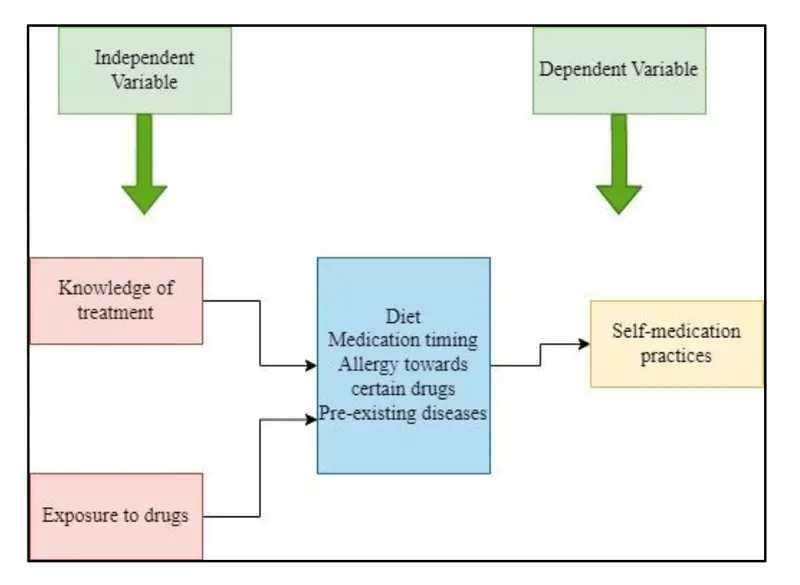
(Source: Self-developed)
7.6. Summary
This chapter has set out what the literature establishes about self-medication among healthcare professionals: that it is common, that access and familiarity drive it, that antibiotics are the class most often involved, and that the harms run from side effects to resistance. Khantzian's self-medication hypothesis has been introduced as the reason the practice can be studied as purposeful behaviour rather than random misuse. What the literature does not settle is whether the knowledge healthcare staff hold restrains the practice or enables it, and that is the gap the conceptual framework is built around.
How Do You Write the Methodology Section of a Research Proposal?
The methodology answers five questions in a fixed order: what you believe counts as knowledge (philosophy), whether you start from theory or from data (approach), what shape the study takes (design), where the data will come from, and how it will be analysed. Each answer is argued against the research questions, not asserted. Sections 8 to 11 below make those five choices for this study, and the figure shows them in sequence.
The five methodological choices in this proposal, in the order they are made
- Philosophy: interpretivism Individual behaviour is not contained by social norms, so the practice is read through training, workplace pressure and personal judgement rather than as a single rate.
- Approach: inductive There is no hypothesis to test. The study starts from the material and works towards the pattern in it.
- Design: exploratory Of six candidate designs, the one that asks what patterns exist rather than how strong a relationship is.
- Data: secondary and qualitative Published studies, healthcare reports and government reports; no survey of the researcher's own.
- Analysis: thematic Four themes, one for each objective. A systematic review would need comparable quantitative studies the literature does not supply.
8. Study Design/Methods
This chapter names the three methodological choices the study rests on, an inductive approach, an interpretivist philosophy and an exploratory design, and justifies each against the research questions, not against convention. The data collection and analysis methods in sections 10 and 11 follow from these three.
What the study rejects and what it chooses
| Point of comparison | Rejected for this study | Chosen for this study |
|---|---|---|
| Philosophy | Rejected for this study Positivism: social patterns explain individual conduct, so behaviour is read off the norms around it | Chosen for this study Interpretivism: individual behaviour is not contained by those norms, and the reality of it is diverse |
| Approach | Rejected for this study Deductive: starts from a hypothesis and tests it against observation | Chosen for this study Inductive: starts from the material and works towards the pattern in it |
| Design | Rejected for this study Experimental and correlational: the study manipulates nothing and produces no variables to correlate | Chosen for this study Exploratory: the questions ask what patterns exist, not how strong a relationship is |
| Why it fits | Rejected for this study A positivist reading would flatten training, workplace pressure and judgement into a single rate | Chosen for this study Self-medication among healthcare staff is shaped by all three at once |
Approach: inductive. A deductive approach starts from a hypothesis and tests it against observation (Bergdahl et al. 2019); an inductive approach starts from the material and works towards the pattern in it. This study asks what treatment knowledge does to self-medication behaviour, which is a question about a pattern that has not yet been specified, so there is no hypothesis to test. Skillman et al. (2019) note that mixing approaches inside one study can pull against the researcher's own interpretive stance, which is a second reason to hold to one.
Philosophy: interpretivism. Research philosophy is the set of beliefs about knowledge that shapes what a researcher counts as a finding (Abu-Alhaija, 2019). Positivism treats social patterns as the explanation of individual conduct, so behaviour is read off the norms around it. Interpretivism holds that individual behaviour is not contained by those norms and that the reality of it is diverse (Alharahsheh and Pius, 2020). Self-medication among healthcare staff is exactly the case interpretivism is built for: the practice is shaped by professional training, by workplace pressure and by personal judgement at once, and a positivist reading would flatten those into a single rate.
Design: exploratory. Of the six designs commonly used, descriptive, exploratory, experimental, correlational, diagnostic and explanatory, only two are candidates here. Descriptive design sets out the features of a problem (Atmowardoyo, 2018) and explanatory design looks for the causes behind them (Toyon, 2021). Experimental and correlational designs are ruled out by the data: this study manipulates nothing and produces no variables to correlate. Exploratory design is chosen because the research questions ask what patterns exist rather than how strong a relationship is, and because the literature on treatment knowledge specifically is thin enough that a narrower design would assume the answer.
9. Study Settings
The setting of a secondary study is the body of literature it reads, not a ward or a clinic, and it has to be named as precisely as a fieldwork site would be. This study will work across peer-reviewed studies of healthcare professionals and health-science students in hospital and university settings in Ethiopia (Fekadu et al. 2020; Mohammed et al. 2021), Kenya (Onchonga et al. 2020), Saudi Arabia (Alrabiah et al. 2022), Iran (Hashemzaei et al. 2021), Serbia (Tomas Petrović et al. 2022), Peru (Quispe-Cañari et al. 2021) and Poland (Makowska et al. 2020), with national expenditure data for the United Kingdom (ONS, 2026).
The spread is deliberate rather than convenient. The literature reports that self-medication practice varies with the health system it sits in (Fekadu et al. 2020), so a single-country reading would answer a narrower question than the one this proposal asks. The limit of the setting is stated for the same reason: it covers what has been published in English and indexed in the databases named in the next section, which under-represents health systems that publish less.
10. Method for Data Collection
Primary and secondary data collection are both available to the researcher. Primary collection produces current information through surveys and interviews run for this study (Ponchio et al. 2021); secondary collection works from existing journals, articles, case studies, healthcare reports and government reports.
The data here will be secondary and qualitative: published studies, healthcare reports and government reports, not a survey of the researcher's own, and words, not numbers. That choice follows the research questions, which ask what treatment knowledge does to behaviour rather than how much of it there is. It also sets a limit named later in this proposal, because a design of this kind cannot produce prevalence figures of its own; where prevalence appears in the literature review it is quoted from the study that measured it.
11. Method for Data Analysis
Two methods are available for secondary qualitative material: a systematic review and a thematic analysis. The second is chosen here because the questions ask what patterns exist in how healthcare professionals use medicines, and because a systematic review would need a body of comparable quantitative studies that this literature does not supply. Four themes are planned, one for each objective.
How Do You Cover Ethics, Reliability and Validity?
Say how participants and data will be protected, how sources are cited, and that nothing has been altered or exaggerated. Then explain why your methods would give the same result if repeated, and why they measure what the research questions ask about. Universities usually want this section before they approve the study.
12. Ethical Regulatory Compliances
This study uses published sources only, so no participants are recruited and no personal data is collected; the ethical duties that remain are those of honest reporting and attribution. The UK Research Integrity Office's Code of Practice for Research asks that findings, including null results, be reported accurately, honestly and completely, and that researchers clearly acknowledge all sources used in their research (UKRIO, 2025). Both are applied here: every study drawn on is cited in the text and listed in full below, figures are carried into the analysis with the study they came from, and nothing in the reviewed material will be altered, selected or exaggerated to fit an expected outcome.
13. Reliability and Validity
Reliability here means that the methods chosen would give similar results if applied again to a similar question, and each of them has been justified above for that reason (Rose and Johnson, 2020).
Validity rests on the same justification of methods. Each choice has been made against the research questions, not for convenience, which is what the paragraphs above set out. Validity cannot be claimed for findings at this stage, because there are none yet: what can be claimed is that the thematic analysis will report only what the reviewed sources state, and that any figure carried into the analysis will be attributed to the study it came from.
14. Dissemination Policy
Dissemination is how the finished work reaches the people who could act on it, and a proposal is expected to say so before the work starts. The completed study will be submitted to the supervisor and the module board as the assessed piece, and deposited in the university repository under its own regulations.
Beyond assessment, the audience for this topic is the people who supervise dispensing, not other researchers. A short summary of the themes, written without academic apparatus, will therefore be offered to hospital education leads and to the professional bodies whose members the reviewed studies describe. If the thematic analysis is strong enough to stand outside the module, the review will be offered to a journal in pharmacy practice or patient safety, and to a student research conference.
No participant data is involved, because every source is already published, so there is nothing to anonymise before release. The single condition on sharing any part of the work is that each reviewed study is attributed, in the form used in the reference list below.
What Does This Proposal Conclude?
Nothing about its own data, because it has none yet. It concludes that the reviewed literature points to easy access and partial knowledge as the drivers of self-medication, that supervision, training and controlled dispensing are the levers worth testing, and that a secondary qualitative review is the right way to test them. It also states its own limits.
15. Conclusion
This proposal has set out what self-medication is as it appears among healthcare professionals, what the literature already establishes about its causes and its harms, and the five questions the study will answer. The part it argues is under-examined is knowledge itself: what changes when the person medicating has been trained to understand the drug.
Khantzian's self-medication hypothesis is the theory the argument rests on, used for one property: it treats self-medication as purposeful behaviour with a cause, which is what makes treatment knowledge a variable that can be tested rather than assumed. Secondary qualitative data, an interpretivist philosophy, an inductive approach and an exploratory design will be used, each justified against the research questions in the methodology above.
The data collection is planned against the objectives rather than reported against them, because no data has been collected. The first objective, identifying self-medication practices and their impact, will be answered by the first theme drawn from the secondary sources; the part played by treatment knowledge by the second theme; the risk factors by the third; and the consequences of incorrect self-medication by the fourth. Whether each theme carries enough evidence to answer its objective is a question for the analysis chapter, not for this proposal, and a proposal that answers it in advance tells the marker it was written last.
Two recommendations follow from the literature even before the study is run. The first is supervision. Both Ethiopian studies close by recommending health education and awareness creation for the safe use of medicines (Fekadu et al. 2020; Mohammed et al. 2021), and this proposal adds that such guidance has to be repeated, not delivered once at induction. The second is access. Where medicines are held on wards, automated dispensing cabinets with access limited by role and a pharmacist's review of each order before a dose is released are the controls the Institute for Safe Medication Practices recommends against diversion (ISMP, 2019); the same controls narrow the access to medicines that 59.1% of the professionals in Mohammed et al. (2021) gave as their reason for self-medicating. Whether either lever works through knowledge, or around it, is what the four themes will show.
The design also sets two limits, and a proposal is stronger for naming them before a marker does. The study will carry no primary statistical or numerical data, because the data will be secondary and qualitative, so it cannot report prevalence of its own and must attribute every figure to the study it came from. The literature itself is also short of numerical data on healthcare professionals specifically, which limits how far the themes can be quantified rather than described.
Primary collection would address both. It was ruled out on time: a secondary qualitative review is what the timescale in the study schedule allows, and the trade is coverage across several countries in exchange for depth in none of them.
Related Research Proposal Samples
Different subjects set the proposal out in different ways. These samples show the same structure applied elsewhere:
- A social media marketing research proposal set in the UK, with a Gantt chart and a qualitative method.
- A business research methods assignment on intercultural virtual teams, written for an MBA module.
- A research proposal on the impact of remote learning during Covid-19.
- A dissertation proposal example on fintech, written section by section as a walkthrough.
- A computer science dissertation sample on a real-time data web app.
- Eleven practical tips for writing a dissertation, for the stage after the proposal is approved.
Need help with a similar healthcare research proposal? Message us on WhatsApp with your topic, your module brief and your deadline, and we will tell you what we can do.
References
- Abu-Alhaija, A.S., 2019. From epistemology to Structural Equation Modeling: An essential guide in understanding the principles of research philosophy in Selecting the Appropriate Methodology. Australian Journal of Basic and Applied Sciences, 13(9), pp.122-128. doi.org/10.22587/ajbas.2019.13.9.12
- Alfonso, C.A., 2021. An Overview of the Psychodynamics of Addiction. Psychodynamic Psychiatry, 49(3), pp.363-369. doi.org/10.1521/pdps.2021.49.3.363
- Alharahsheh, H.H. and Pius, A., 2020. A review of key paradigms: Positivism VS interpretivism. Global Academic Journal of Humanities and Social Sciences, 2(3), pp.39-43. gajrc.com
- Alrabiah, Z., Arafah, A., Rehman, M.U., Babelghaith, S.D., Syed, W., Alrashidi, F.K., Aldajaani, F.F., Alsufayan, M.A. and Arifi, M.N.A., 2022. Prevalence and Self-Medication for Acne among Students of Health-Related Science Colleges at King Saud University in Riyadh Region Saudi Arabia. Medicina, 59(1), p.52. doi.org/10.3390/medicina59010052
- Atmowardoyo, H., 2018. Research methods in TEFL studies: Descriptive research, case study, error analysis, and R & D. Journal of Language Teaching and Research, 9(1), pp.197-204. doi.org/10.17507/jltr.0901.25
- Bergdahl, E., Ternestedt, B.M., Berterö, C. and Andershed, B., 2019. The theory of a co-creative process in advanced palliative home care nursing encounters: A qualitative deductive approach over time. Nursing Open, 6(1), pp.175-188. doi.org/10.1002/nop2.203
- Doomra, R. and Goyal, A., 2020. NSAIDs and self-medication: A serious concern. Journal of Family Medicine and Primary Care, 9(5), p.2183. doi.org/10.4103/jfmpc.jfmpc_201_20
- Elden, N.M.K., Nasser, H.A., Alli, A., Mahmoud, N., Shawky, M.A., Ibrahim, A.A.E.A. and Fahmy, A.K., 2020. Risk factors of antibiotics self-medication practices among university students in Cairo, Egypt. Open Access Macedonian Journal of Medical Sciences, 8(E), pp.7-12. doi.org/10.3889/oamjms.2020.3323
- Fekadu, G., Dugassa, D., Negera, G.Z., Woyessa, T.B., Turi, E., Tolossa, T., Fetensa, G., Assefa, L., Getachew, M. and Shibiru, T., 2020. Self-medication practices and associated factors among health-care professionals in selected hospitals of Western Ethiopia. Patient Preference and Adherence, pp.353-361. doi.org/10.2147/PPA.S244163
- Hashemzaei, M., Afshari, M., Koohkan, Z., Bazi, A., Rezaee, R. and Tabrizian, K., 2021. Knowledge, attitude, and practice of pharmacy and medical students regarding self-medication, a study in Zabol University of Medical Sciences; Sistan and Baluchestan province in south-east of Iran. BMC Medical Education, 21(1), pp.1-10. doi.org/10.1186/s12909-020-02374-0
- Institute for Safe Medication Practices (ISMP), 2019. Guidelines for the Safe Use of Automated Dispensing Cabinets. ismp.org [Accessed 24 September 2026].
- Khantzian, E.J., 1985. The self-medication hypothesis of addictive disorders: focus on heroin and cocaine dependence. American Journal of Psychiatry, 142(11), pp.1259-1264. doi.org/10.1176/ajp.142.11.1259
- Khantzian, E.J., 1997. The self-medication hypothesis of substance use disorders: a reconsideration and recent applications. Harvard Review of Psychiatry, 4(5), pp.231-244. doi.org/10.3109/10673229709030550
- Makowska, M., Boguszewski, R., Nowakowski, M. and Podkowińska, M., 2020. Self-medication-related behaviors and Poland's COVID-19 lockdown. International Journal of Environmental Research and Public Health, 17(22), p.8344. doi.org/10.3390/ijerph17228344
- Mohammed, S.A., Tsega, G. and Hailu, A.D., 2021. Self-medication practice and associated factors among health care professionals at Debre Markos comprehensive specialized hospital, northwest Ethiopia. Drug, Healthcare and Patient Safety, pp.19-28. doi.org/10.2147/DHPS.S290662
- Okoye, O.C., Adejumo, O.A., Opadeyi, A.O., Madubuko, C.R., Ntaji, M., Okonkwo, K.C., Edeki, I.R., Agboje, U.O., Alli, O.E. and Ohaju-Obodo, J.O., 2022. Self medication practices and its determinants in health care professionals during the coronavirus disease-2019 pandemic: cross-sectional study. International Journal of Clinical Pharmacy, 44(2), pp.507-516. doi.org/10.1007/s11096-021-01374-4
- Onchonga, D., Omwoyo, J. and Nyamamba, D., 2020. Assessing the prevalence of self-medication among healthcare workers before and during the 2019 SARS-CoV-2 (COVID-19) pandemic in Kenya. Saudi Pharmaceutical Journal, 28(10), pp.1149-1154. doi.org/10.1016/j.jsps.2020.08.003
- Office for National Statistics (ONS), 2026. Healthcare expenditure, UK Health Accounts: 2024 and 2025. Statistical bulletin, released 29 April 2026. ons.gov.uk [Accessed 24 September 2026].
- Ponchio, M.C., Barth, N.L. and Zambaldi, F., 2021. Using the internet for data collection in business research. RAUSP Management Journal, 56, pp.254-258. doi.org/10.1108/RAUSP-04-2021-251
- Quincho-Lopez, A., Benites-Ibarra, C.A., Hilario-Gomez, M.M., Quijano-Escate, R. and Taype-Rondan, A., 2021. Self-medication practices to prevent or manage COVID-19: A systematic review. PLoS One, 16(11), p.e0259317. doi.org/10.1371/journal.pone.0259317
- Quispe-Cañari, J.F., Fidel-Rosales, E., Manrique, D., Mascaró-Zan, J., Huamán-Castillón, K.M., Chamorro-Espinoza, S.E., Garayar-Peceros, H., Ponce-López, V.L., Sifuentes-Rosales, J., Alvarez-Risco, A. and Yáñez, J.A., 2021. Self-medication practices during the COVID-19 pandemic among the adult population in Peru: A cross-sectional survey. Saudi Pharmaceutical Journal, 29(1), pp.1-11. doi.org/10.1016/j.jsps.2020.12.001
- Rose, J. and Johnson, C.W., 2020. Contextualizing reliability and validity in qualitative research: toward more rigorous and trustworthy qualitative social science in leisure research. Journal of Leisure Research, 51(4), pp.432-451. doi.org/10.1080/00222216.2020.1722042
- Skillman, M., Cross-Barnet, C., Friedman Singer, R., Rotondo, C., Ruiz, S. and Moiduddin, A., 2019. A framework for rigorous qualitative research as a component of mixed method rapid-cycle evaluation. Qualitative Health Research, 29(2), pp.279-289. doi.org/10.1177/1049732318795675
- Tesfamariam, S., Anand, I.S., Kaleab, G., Berhane, S., Woldai, B., Habte, E. and Russom, M., 2019. Self-medication with over the counter drugs, prevalence of risky practice and its associated factors in pharmacy outlets of Asmara, Eritrea. BMC Public Health, 19, 159. doi.org/10.1186/s12889-019-6470-5
- Tomas Petrović, A., Pavlović, N., Stilinović, N., Lalović, N., Paut Kusturica, M., Dugandžija, T., Zaklan, D. and Horvat, O., 2022. Self-Medication Perceptions and Practice of Medical and Pharmacy Students in Serbia. International Journal of Environmental Research and Public Health, 19(3), p.1193. doi.org/10.3390/ijerph19031193
- Toyon, M.A.S., 2021. Explanatory sequential design of mixed methods research: Phases and challenges. International Journal of Research in Business and Social Science (2147-4478), 10(5), pp.253-260. doi.org/10.20525/ijrbs.v10i5.1262
- UK Research Integrity Office (UKRIO), 2025. Code of Practice for Research: Promoting good practice and preventing misconduct, version 3.5. ukrio.org [Accessed 24 September 2026].
- WHO, 2026. Antimicrobial resistance. World Health Organization fact sheet. who.int [Accessed 18 September 2026].
- Zhang, A., Hobman, E.V., De Barro, P., Young, A., Carter, D.J. and Byrne, M., 2021. Self-medication with antibiotics for protection against COVID-19: the role of psychological distress, knowledge of, and experiences with antibiotics. Antibiotics, 10(3), p.232. doi.org/10.3390/antibiotics10030232
Frequently Asked Questions
What is a research proposal?
A research proposal is a short document that sets out what you plan to research, why it matters, what other researchers have already found, and how you will collect and analyse your data. Your supervisor reads it before approving the study. Most proposals also cover ethics, timescale and the sources you will use.
What should a research proposal include?
An abstract, a background and rationale, the theory you build on, one aim with its objectives and research questions, a literature review, a methodology, a section on ethics, reliability and validity, and a reference list. Some briefs also ask for a study schedule and a dissemination plan; the example on this page has both. Check your brief for the sections it names and the order it wants them in.
How long is a research proposal?
Your university's brief sets the word count, so check it before you plan the sections. The proposal on this page runs to roughly 4,500 words excluding the reference list and our own commentary, because it carries a full literature review as well as a methodology chapter. A proposal that stops at the methodology will be considerably shorter.
How do you write the methodology section of a research proposal?
Name your philosophy, approach and design, then justify each one against your research questions. Say where the data will come from, whether it is primary or secondary, qualitative or quantitative, and how you will analyse it. This proposal uses interpretivism, an inductive approach, an exploratory design, secondary qualitative sources and thematic analysis.
Can I use this research proposal example for my own work?
Use it as a structure, not as a submission. Copying any published sample is plagiarism, and your topic, module and reading list will differ from this one. Read how the aim turns into objectives and then into research questions, then write your own. We write every proposal we take on from scratch.