
BYD Marketing Strategy and Sustainability Analysis | Case Study
A strategic marketing case study on BYD, written for a postgraduate management module. It applies Ansoff growth strategies, the resource-based view, and a competitor analysis against CBAK Energy Technology and Farasis Energy, then sets out innovation, international marketing and the risks BYD faces. BYD's 2025 sales, its reported emissions and the state of its overseas factories come from cited sources.
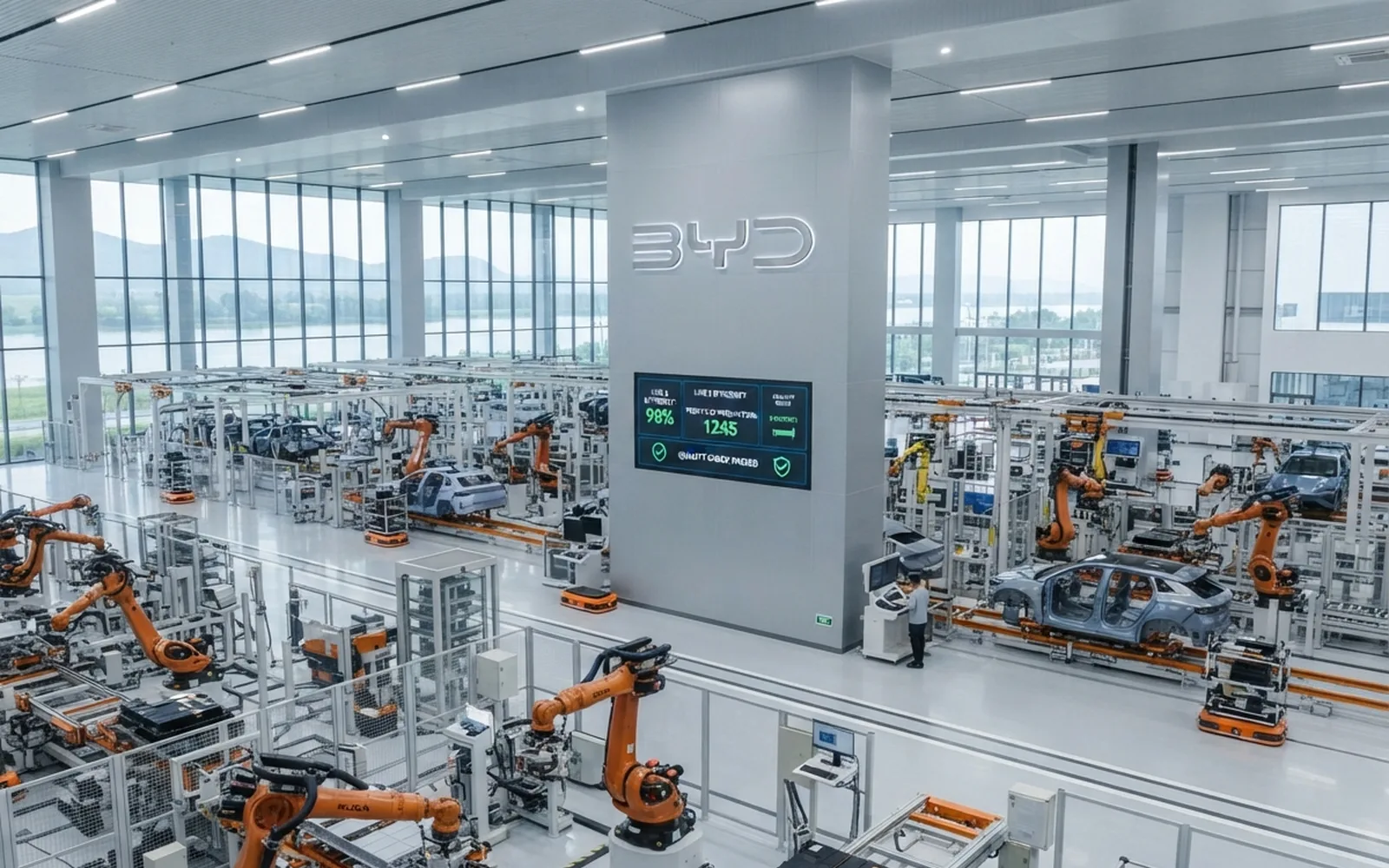
This is a postgraduate strategic marketing case study on BYD, the Chinese group that builds electric vehicles, batteries and energy-storage systems. It applies four frameworks: growth and market-entry strategies, the resource-based view of competitive advantage, a structured competitor analysis, and a risk assessment. The original analysis draws on sources to 2022; company detail, 2025 sales figures and plant status as of September 2026 have been added and sourced below.
One note on naming before you read it. The report says "BYD Energy" throughout, which is why its competitor set is battery makers rather than carmakers. The parent company is BYD Company Limited, and BYD Energy Storage is its energy-storage division. If your own brief names the parent company, widen the competitor set to include Tesla and the other volume carmakers. Two habits a marker rewards, and which this sample shows: it states the operating mission the evidence supports rather than the published one alone, and it names the measure of competitiveness it is using before it declares a winner.
For the service page, see MBA and management assignment help, or browse more MBA assignment samples.
About BYD
BYD Company Limited is a Chinese manufacturer of electric vehicles, rechargeable batteries, electronics assemblies and energy-storage systems, and its own About page groups the business into four lines: automobiles, rail transit, renewable energy and electronics (BYD, About BYD). It was founded in 1995 to make rechargeable cells for mobile phone manufacturers, and moved into carmaking in 2003 by buying 77 per cent of Xi'an Qinchuan Automobile for HKD 254 million, roughly USD 32.7 million at the time (CKGSB Knowledge).
The division this report calls BYD Energy is BYD Energy Storage. Its consumer and commercial product is the Battery-Box range: modular lithium iron phosphate systems sold in high-voltage (HVS, HVM, HVL) and low-voltage (LVS, LVL) series, scaling from a single unit of a few kilowatt hours in a house up to several hundred kilowatt hours on a commercial site (BYD Battery-Box). The chemistry is deliberately cobalt free, which matters both to cost and to the sustainability claim the group makes about itself. The vehicle business is the part most readers will know: BYD sold 4,602,436 new energy vehicles in 2025 (Gasgoo, 2026a).
Introduction
BYD, whose name stands for Build Your Dreams, began in 1995 as a maker of rechargeable cells and sold 4,602,436 new energy vehicles in 2025 (Gasgoo, 2026a), which makes it the clearest available case of a component supplier that became a vehicle brand. This report sets out a strategic marketing analysis of the company in four parts: a critical company analysis of its mission and growth directions, a resource-based reading of its competitive advantage, a critical competitive and customer analysis, and the challenges it faces in future. The question the report keeps returning to is what owning the battery does to every other decision.
Critical Company Analysis of BYD
The company analysis below works through BYD's stated purpose and then through the four growth directions in the Ansoff matrix, plus acquisition as a fifth route. The point of the framework is not to label BYD's moves but to ask which direction the company is actually resourced for, and what each one costs it.
Mission and Vision
A mission statement should say why an organization exists, what it sells and to whom; a vision should say where it intends to be by a stated date. BYD presents itself around technological innovation and groups the business into four lines: automobiles, rail transit, renewable energy and electronics (BYD, About BYD). Read against what the company does rather than what it says, the working mission is narrower and more useful for analysis: to remove the cost premium from zero-emission transport and storage by making the expensive parts itself.
That reading explains decisions a broader mission statement would not. It explains why a battery company bought a carmaker rather than the other way round, why the group has stayed in cobalt-free lithium iron phosphate chemistry when rivals moved to nickel-rich cells, and why the energy-storage division sells the same chemistry into homes and commercial sites. This report therefore states the published mission, then the operating mission the evidence supports, and accounts for the gap between them.
Directional and Growth Strategies
Directional strategy asks which way an organization should grow when it has more than one option and cannot fund all of them. The Ansoff matrix gives four directions, set by whether the product and the market are existing or new: market penetration, market development, product development, and diversification (Ansoff, 1957). Acquisition sits outside the matrix as a means rather than a direction, but it belongs in this analysis because BYD has used it at two decisive moments.
BYD is unusual in running all four directions at once, and it can do so because the same battery plant serves the car business, the bus business and the storage business. The cost of adding a direction is therefore lower for BYD than for a company that would have to buy its cells. That is the thread running through the four sections below: the growth strategy is a consequence of the resource position, not a separate choice.
Market Penetration Strategy
Market penetration means selling more of an existing product in an existing market, and the usual lever is price. BYD's domestic strategy has been exactly that: keep the model range in the market it already serves, and move the price down as manufacturing cost falls. Because the company builds its own cells, a fall in cell cost reaches the sticker price faster than it does for a carmaker buying from a supplier, and that is the mechanism behind the volume.
The result is visible in the 2025 figures. BYD sold 4,602,436 new energy vehicles in the year, of which 2,256,714 were battery electric, a rise of 27.86 per cent on the previous year (Gasgoo, 2026a). Penetration has a ceiling, though, and the 7.73 per cent overall growth against 27.86 per cent in the pure-electric mix suggests BYD is now converting its own plug-in hybrid buyers as much as it is taking share from rivals. That is the point at which a company has to look outside its home market, which is the next section.
Also read our sample on the marketing strategy of H&M, which works through a penetration strategy in a different industry.
Market Expansion and Development Strategy
Market development means selling an existing product in a new market. BYD has moved through the standard sequence: export first, then assemble locally, then manufacture locally. Its first wholly owned passenger-car plant outside China was inaugurated at Rayong in Thailand on 4 July 2024, a USD 490 million site with capacity for 150,000 vehicles a year that Thailand's Board of Investment described as a production hub for export to ASEAN (Investment Monitor, 2024). The plant built its 100,000th vehicle on 21 September 2026, about 26 months after it began operating (CnEVPost, 2026c).
Brazil and Hungary follow the same logic, and both were still short of full production in September 2026. BYD has built electric buses in Brazil since 2015 (BYD Company). Its passenger-car plant at Camaçari in Bahia rolled out its first vehicle, a Dolphin Mini, on 1 July 2025 from semi-knocked-down kits, with a stated capacity of 150,000 vehicles a year and a gradual move to full local manufacture (BYD, 2025b), which the company expects to complete by December 2026 (just-auto, 2025). The plant at Szeged in Hungary began trial production at the end of January 2026, about a year behind the original schedule, with a planned capacity of 200,000 vehicles a year (electrive, 2026); in June 2026 the company said series production would start in the fourth quarter of 2026 (just-auto, 2026). Local manufacture answers two problems at once: it removes the shipping and tariff cost that makes an exported car uncompetitive, and it gives the company a domestic-producer standing in markets where that matters politically. The cost is that capacity built for one market cannot be redeployed if demand appears somewhere else, which is the risk a market-development strategy always carries.
Product Expansion Strategy
Product development means new or improved products sold into the market a company already serves, and for BYD the product that keeps being redeveloped is the battery. The Blade Battery, a lithium iron phosphate pack in a long, thin cell format with honeycomb construction inside each blade, was introduced to raise packaging efficiency and safety at the same time; BYD makes the point that the pack passes the nail penetration test and that the chemistry uses neither nickel nor cobalt (BYD, Blade Battery).
The Super e-Platform, announced in March 2025, is the same strategy applied to charging rather than storage. It pairs a 1,000-volt architecture with a 1,000-amp current to reach a charging power of one megawatt, which BYD describes as adding about two kilometers of range per second, with the Han L and Tang L as the first models and a plan for more than 4,000 flash-charging terminals in China (BYD, 2025a). For the analysis, the important thing is not the specification but the pattern: BYD develops the component that is the binding constraint on the customer's decision, then sells the improvement as a reason to buy the existing car.
Growth Through Diversification
Diversification means a new product in a new market and is the riskiest of the four directions, because neither the product nor the customer is familiar. BYD's diversification is broader than the car business suggests. Alongside passenger cars it builds electric buses and commercial vehicles, rail transit systems, forklifts, electronics assemblies through BYD Electronics, and grid and residential energy storage (BYD, About BYD; BYD Battery-Box). BYD Electronics was created as a subsidiary in 2002 and listed in Hong Kong in 2007 (BYD Company).
What makes this less risky for BYD than the framework implies is that most of these businesses consume the same cells, the same power electronics and the same manufacturing skills. A diversification that shares a resource base is closer to related diversification than to conglomerate diversification, and it earns a lower risk premium as a result. The premium brands, Denza, Yangwang and Fang Cheng Bao, are a different kind of move: they are an attempt to reach a customer who will not buy a car with a value brand on it, and they carry the ordinary risk of a new brand rather than a new technology.
Acquisition of Other Companies
Acquisition lets a company enter an established market without building the position from scratch, and it converts the time cost of entry into a capital cost. BYD's decisive example is the one that created the car business. In 2003 it bought 77 per cent of Xi'an Qinchuan Automobile for HKD 254 million, buying a manufacturing license, a plant and a workforce that would have taken years to assemble, and accelerating its battery industrialization by an estimated two to three years (CKGSB Knowledge).
The second example is narrower and more recent: BYD Electronics agreed in August 2023 to buy several Chinese factories operated by the American contract manufacturer Jabil, adding capacity and customer relationships in mobile electronics (BYD Company). Both deals follow the same rule. BYD buys where the asset is a plant and a license, and builds where the asset is a technology, because the technology is the thing it does not want anyone else to own.
What Is BYD's Competitive Advantage?
Vertical integration in batteries. Because BYD started as a rechargeable battery maker in 1995, it owns the most expensive component in an electric vehicle rather than buying it. The resource-based view splits that advantage into four parts: tangible assets, intangible assets, market assets and technology, each examined below.
The resource-based view holds that a durable advantage comes from resources a competitor cannot easily buy, copy or substitute. BYD's case is instructive because the resource is not a secret: everyone knows the company makes its own cells. The advantage survives anyway, because replicating it means building cell plants, which takes capital and years, and because BYD ran the integration further than most. For a long period the company held that everything except the tires and the glass was made in-house, although since 2017 it has sourced more parts from outside suppliers where they are capable (CKGSB Knowledge). That partial retreat is itself worth analyzing: full integration buys control and costs flexibility.
Tangible Assets
The tangible resources are the plants, the tooling and the capital behind them. BYD manufactures cells and vehicles at multiple sites in China through its FinDreams component subsidiaries (BYD Company). Abroad, one passenger-car plant is in full operation: Rayong in Thailand, inaugurated in July 2024 with a capacity of 150,000 vehicles a year (BYD, 2024). Two more are being brought up: Camaçari in Brazil, assembling from kits since July 2025 with full production expected by the end of 2026 (BYD, 2025b; just-auto, 2025), and Szeged in Hungary, in trial production since January 2026 with series production due in the fourth quarter of 2026 and a planned capacity of 200,000 vehicles a year (electrive, 2026; just-auto, 2026). The Thailand site represents USD 490 million of fixed investment for 150,000 units of annual capacity (Investment Monitor, 2024), which gives a usable rule of thumb for how much capital a unit of capacity costs in this industry.
Tangible assets are the weakest part of a resource-based argument, because a competitor with money can buy the same machines. What makes BYD's plant valuable is not the plant but where it sits in the chain: a company that owns both the cell line and the assembly line can change a pack design without renegotiating a supply contract. That is a coordination advantage attached to a physical asset, and it is much harder to copy than the asset itself. In resource-based terms the plant is valuable but imitable; the position of the plant in the chain is what is hard to imitate, and imitability is the condition that decides whether an advantage lasts (Barney, 1991).
Intangible Assets
The intangible resources are the patents, the brand and the accumulated process knowledge. The Blade Battery is the clearest example of a product BYD developed rather than bought: a lithium iron phosphate cell with a honeycomb construction inside each blade, which the company says lets the pack pass the nail penetration test (BYD, Blade Battery). Trade marks matter for the ordinary commercial reason that a protected name cannot be used by another seller, and BYD's brand architecture now covers a value marque and three premium ones.
The less visible intangible is manufacturing know-how. Thirty years of building cells produces a body of process knowledge that is not written down anywhere a competitor could read it, and that is the classic resource-based condition: valuable, rare, hard to imitate and hard to substitute. Each of the four conditions holds for it, which is why process knowledge, rather than the brand, is the intangible that carries the advantage.
Market Assets
Market assets are the channels and relationships through which a company reaches buyers. BYD's are unusually varied: its own dealer networks and national importers across Asia, Europe and Latin America, fleet and municipal contracts for buses, business-to-business channels for storage, and distribution partners for the Battery-Box line sold through solar installers rather than through car showrooms (BYD Battery-Box). Overseas sales passed one million units for the first time in 2025, at 1,046,083 including commercial vehicles (CnEVPost, 2026a), which is the measure of how far that channel has been built out.
Promotion is the smallest of these assets. BYD does advertise, and it uses social platforms and motor shows like everyone else, but its reach is carried by price and by distribution rather than by campaign spend, so the market assets that matter are the channels, not the campaigns.
Technology
Technology is the resource BYD guards most closely, and the record shows a company that develops the component on which the customer's objection rests. When the objection was safety, it produced the Blade Battery in a cobalt-free chemistry that passes the nail penetration test (BYD, Blade Battery). When the objection became charging time, it produced the Super e-Platform, a 1,000-volt, 1,000-amp architecture delivering one megawatt of charging power (BYD, 2025a).
The strategic reading is that BYD treats technology as a marketing asset rather than an engineering one. Each development is aimed at a reason not to buy, and each is announced to consumers rather than to the trade. That is a defensible competitive position for as long as the company keeps finding the next objection, and it is vulnerable at the moment a rival solves one of them first.
Who Are BYD's Competitors?
This assignment compares BYD with two battery makers, CBAK Energy Technology and Farasis Energy, on four criteria: profiling, strategy, competence and competitiveness. Both rivals compete on lithium-ion cell performance and cost. In the vehicle market BYD's principal rival is Tesla, and 2025 was the first year BYD sold more battery electric vehicles than Tesla did: 2,256,714 against 1,636,129 deliveries (CnEVPost, 2026b). Our SWOT analysis of Tesla works through the same year from Tesla's side of that comparison. For BYD's own position on its 2025 annual report and 2026 interim report, read our SWOT analysis of BYD.
Battery electric vehicle sales, 2025: BYD against Tesla
Chart data
| Item | Value (units) |
|---|---|
| BYD | 2,256,714 units |
| Tesla | 1,636,129 units |
BYD against the two specialist cell makers in this report
| Point of comparison | BYD | CBAK Energy Technology | Farasis Energy |
|---|---|---|---|
| Cell format and chemistry | BYD Prismatic Blade cell, lithium iron phosphate, built to be structural | CBAK Energy Technology Cylindrical lithium iron phosphate cells, plus a sodium-ion series | Farasis Energy Pouch cells, nickel manganese cobalt |
| Main customer | BYD Itself: the cells go into BYD vehicles, buses and storage | CBAK Energy Technology Light electric vehicles, new energy vehicles, portable and home storage | Farasis Energy A few premium carmakers; Mercedes-Benz holds around three per cent |
| Where it wins | BYD Cost per kilowatt hour at volume | CBAK Energy Technology Responsiveness to a small customer with an unusual specification | Farasis Energy Energy density and a German customer's release discipline |
| Risk carried | BYD Vertical integration: exposed if its own vehicles stop selling | CBAK Energy Technology Cannot compete on scale; depends on chemistry and service | Farasis Energy Concentration: a few customers' volume risk lands on the supplier |
Choosing a competitor set is a decision, not a given, and the choice here follows from the report's framing of BYD as an energy business. Read as a carmaker, BYD competes with Tesla and the volume manufacturers. Read as a cell maker, it competes with CATL and then with the second tier that CBAK and Farasis occupy. The two chosen here are useful precisely because they are smaller: they show what a specialist without a vehicle business has to do to survive, which is the contrast that makes BYD's integration visible.
CBAK Energy Technology
Profile. CBAK Energy Technology, founded in 2001 and the first China-based lithium battery company listed on Nasdaq (CBAT), develops, manufactures and sells cylindrical lithium iron phosphate cells and a sodium-ion series, with production and research sites at Dalian, Nanjing and Shangqiu and a materials base at Shaoxing (CBAK Energy). Its cells go into light electric vehicles, new energy vehicles, and portable and home energy storage, which puts it in the same two end markets as BYD.
Strategy. CBAK's strategy is to specialize where a large integrated maker is inefficient: cylindrical cells for light electric vehicles and for storage, and a second chemistry, sodium-ion, that trades energy density for cost and raw-material security. The contrast with BYD is the point. CBAK cannot win on scale, so it competes on chemistry and on serving customers whose volumes are too small to interest a company selling millions of vehicles a year.
Competence. The competence that keeps a specialist alive is the ability to qualify a new cell for a customer quickly, which depends on materials research and on test capacity rather than on plant size. BYD's answer is different and comes from the other direction: it can change a cell because it also owns the product the cell goes into, so the qualification customer is itself.
Competitiveness. Measured on cost per kilowatt hour at volume, BYD wins and CBAK does not try to compete. Measured on responsiveness to a small customer with an unusual specification, the ranking reverses. This report uses the first measure, and says so, because the two give opposite answers.
Farasis Energy
Profile. Farasis Energy is a Chinese maker of lithium-ion pouch cells for electric mobility and stationary storage. It produces in China at Ganzhou and Zhenjiang; when its Ganzhou expansion was reported in 2022 the Ganzhou site held about 5 GWh of capacity and the larger Zhenjiang plant about 16 GWh (electrive, 2022). In July 2020 Mercedes-Benz took a stake of around three per cent in the company for a multi-million euro sum, alongside a partnership on cell development, and Farasis is building a cell plant at Bitterfeld-Wolfen in Germany to supply it (electrive, 2020).
Strategy. Farasis has chosen the pouch format, which offers better packaging efficiency at cell level but needs more support structure at pack level, and it has chosen to attach itself to a small number of premium customers rather than to sell broadly. That is the opposite of BYD's position on both counts: BYD's prismatic blade format is designed to be structural, and its main customer is itself.
Competence. The competence being bought by a premium carmaker is energy density and the development discipline that goes with a German customer's release process. Farasis competes on the performance of the cell rather than on its price, which suits a partner selling expensive cars.
Competitiveness. The risk in Farasis's position is concentration: a strategy built on a small number of large customers transfers the customer's volume risk onto the supplier. BYD carries the opposite risk, which is that vertical integration leaves it exposed if its own vehicles stop selling. Neither structure is safer in the abstract; they fail in different conditions.
Critical Customer Analysis
BYD sells to three distinct customers who do not buy the same way. The first is the private car buyer, who is price sensitive, compares on range, charging time and running cost, and in most markets is buying an electric vehicle for the first time. The second is the fleet or municipal buyer of buses and commercial vehicles, who buys on total cost of ownership over a decade and on the reliability of parts supply. The third is the energy-storage customer, either a household adding storage to a solar installation or a commercial site managing demand charges, who buys through an installer and rarely knows the brand before the installer names it.
The 2025 export mix shows how much the first of those varies by country: plug-in hybrids lead in Mexico, Brazil and Turkey, while fully electric models lead in Thailand and Indonesia (Gasgoo, 2026a). Charging infrastructure and fuel prices, not taste, explain most of that split, and it is a warning against writing a single global customer profile. For this company, understanding the customer means understanding which technical objection is binding in which market, which is why research and development belongs inside the customer analysis rather than beside it.
Strategic Collaboration and Contextual Factors
The contextual factors that shape BYD's strategy are mostly political. Purchase incentives, tariffs and local-content rules decide where a vehicle can be sold profitably, and they change faster than a factory can be built. The European Union's definitive countervailing duties on battery electric vehicles from China are the clearest example: applicable from 30 October 2024 for five years, and set at 17.0 per cent for BYD (European Commission, 2024). A car built at Szeged is not an import, which is why the Hungarian plant exists. The full external scan, with the US tariff stack, China's purchase-tax change and the EU's battery and CO2 rules each dated to its document, is in our PESTEL analysis of BYD.
Collaboration is where BYD is least conventional. Where most carmakers form joint ventures to acquire technology they lack, BYD's partnerships mostly distribute a technology it already owns, through national importers, bus contracts and storage installers. The strategic consequence is that BYD keeps more margin and more control, and carries more of the market risk itself. As customer preferences shift with technology, the company has to absorb that shift internally rather than share it with a partner.
How Does BYD Approach Innovation?
As a requirement of the product rather than a marketing exercise. BYD sells storage and zero-emission systems, so an unchanged product line loses value as cell chemistry and efficiency improve. The company therefore invests in battery and drivetrain technology continuously, across residential, commercial and grid-scale projects, and treats that pipeline as its defense against imitation.
BYD is a technology company before it is a carmaker, and its innovation is concentrated in the parts of a product that decide whether a customer buys. Innovation in this business means new cell chemistry, new pack architecture, new power electronics and new charging hardware, rather than new features layered on an existing design. The company builds efficient, safe and stable storage for renewable energy, and that market rewards incremental gains in energy density and cycle life every year, so a product line left alone for three years is worth measurably less than it was.
Two examples show the method. The Blade Battery answered a safety objection with a structural change to the cell and the pack rather than with a warranty promise: lithium iron phosphate chemistry and a honeycomb construction that the company says lets it pass the nail penetration test (BYD, Blade Battery). The Super e-Platform answered a charging-time objection with a 1,000-volt, 1,000-amp architecture delivering a megawatt of charging power, launched alongside a commitment to build the charging terminals that make it usable (BYD, 2025a). In both cases the innovation was aimed at a reason not to buy, and in both cases the company built the complementary asset, the pack or the charger, that the innovation needed to be worth anything.
The strategic case for spending at this rate is that it raises the cost of imitation. A rival can copy a feature; it cannot easily copy a cell plant, a patent estate and a charging network at the same time. The risk attached to the same strategy is that heavy internal development makes a company slow to adopt a technology invented elsewhere, and there is some evidence of that in BYD's decision to source more components externally after 2017 (CKGSB Knowledge). Innovation also has an efficiency dimension that fits the sustainability argument: a process improvement that cuts material waste lowers both cost and environmental impact, which is why the two goals rarely conflict in this industry. The theory behind this section, from the 4Ps of innovation to the tools a firm uses to protect what it develops, is worked through in our innovation and commercialization sample.
What Is BYD's Sustainability Strategy?
A product claim and a company footprint, which point in opposite directions. The product claim is cobalt-free lithium iron phosphate cells and a fleet that displaces fuel vehicles. The footprint is the emissions of making 4.6 million vehicles a year, which rise with output. An analysis has to hold both; a marker will ask which one the evidence is about.
On the product side, BYD's 2025 ESG report puts the carbon avoided by its vehicles in production and use, measured against fuel vehicles, at 46.6 million tons for the year, reports 7.29 billion kWh of clean electricity used, and sets a target of carbon neutrality across the whole value chain by 2045 (Gasgoo, 2026b). The same report gives research and development spending of 63.4 billion yuan, 7.89 per cent of revenue, which is the budget behind the cobalt-free chemistry and the charging platform described above.
On the company side, BYD's own reporting shows total greenhouse gas emissions of 8,061,970 tons in 2022 against 5,219,112 tons in 2021, a rise of more than half in one year, at an intensity of 0.19011 tons per RMB 10,000 of revenue, and it framed its targets at that point around China's national goals of peak carbon in 2030 and neutrality in 2060 rather than around a dated absolute cut of its own (just-auto, 2024). Sales have more than doubled since 2022 (BYD Company), and the report cited here gives no later absolute figure. The defensible sustainability position is therefore that BYD's product lowers emissions in the fleet while its own footprint grows with every plant, and the 2045 value-chain target is the company-level commitment that addresses that gap.
What Is BYD's International Marketing Strategy?
Adapt the product to the market, then build locally. BYD studies demand, taste and government policy in each country before choosing which model to sell, checks that raw materials and technology are available at an acceptable cost, and tests the product against local culture. Where volume justifies it, manufacturing follows the market.
International expansion is how a manufacturer at the ceiling of its home market keeps growing, and it exposes the company to constraints that do not apply at home. Customer preference is the first: the product has to be built to the demand and taste of the market it is sold in, which for cars means body style, equipment level and drivetrain, and the 2025 export mix shows that the drivetrain choice already differs by country. Government policy is the second: every country sets its own rules on emissions, incentives, safety approval and local content, and a firm has to satisfy them before it can trade. Marketing strategy therefore has to be set market by market.
Also read our sample on LEGO marketing strategy and research analysis, which covers market entry through a local partner.
Cost is the constraint that decides the entry mode. If a product can be built in a country, the question is whether it can be built there at a price the market will pay; if the raw materials have to be imported, the landed cost may make the exercise pointless. BYD's answer has been to move production to the market once volume justifies the capital: Thailand first, as an export hub for ASEAN, then Brazil and Hungary, at the stages set out under tangible assets above. Choosing the right product for each market, and planning the strategy around it, is what makes an international business work rather than merely exist.
How Is BYD Performing in 2025 and 2026?
The international strategy described above has now delivered. BYD sold 4,602,436 new energy vehicles in 2025, up 7.73 per cent year on year, of which a record 2,256,714 were battery electric, up 27.86 per cent. Overseas sales passed one million units for the first time, and December exports reached about 133,000, a rise of roughly 145 per cent on the same month a year earlier (Gasgoo, 2026a).
BYD in 2025, and the 2026 overseas target
- New energy vehicles sold, 2025
- 4,602,436 Up 7.73 per cent on 2024.
- Battery electric vehicles, 2025
- 2,256,714 Up 27.86 per cent; a record.
- Overseas sales, 2025
- 1,046,083 Passenger and commercial vehicles, up 150.74 per cent; the first year above one million (CnEVPost, 24 January 2026).
- Exports in December 2025
- 133,000 Up about 145 per cent year on year.
- Overseas sales target, 2026
- 1.3m About 24 per cent above 2025 (CnEVPost, 24 January 2026).
Three details follow from those figures. First, the mix differs by region: plug-in hybrids lead in Mexico, Brazil and Turkey, while fully electric models lead in Thailand and Indonesia, which is direct evidence for the adaptation argument above. Second, the entry mode is shifting from export towards local production, but only Thailand has completed the shift: Rayong passed 100,000 vehicles built in September 2026 (CnEVPost, 2026c), Camaçari has assembled kits since July 2025 with full production expected by the end of 2026 (BYD, 2025b; just-auto, 2025), Szeged is in trial production with series output due in the fourth quarter of 2026 (just-auto, 2026), and in May 2025 the company announced a European headquarters and research center in Budapest covering sales and after-sales, vehicle certification and testing, and localized vehicle design (electrive, 2025). Third, BYD has set an overseas target of 1.3 million vehicles for 2026, about 24 per cent above the 1,046,083 it exported in 2025 (CnEVPost, 2026a), against a domestic market where the purchase-tax exemption on new energy vehicles was halved from 1 January 2026, with the relief capped at RMB 15,000 a vehicle (China Briefing, 2023).
What Challenges Does BYD Face?
Four internal risks: information security, a shortage of technical skills as tooling changes, the cost of rebuilding infrastructure when technology moves, and data management discipline. Two external ones follow from the 2025 figures: dependence on export growth while the domestic purchase-tax relief is halved, and a 17.0 per cent EU duty on cars shipped from China.
The common factor in the internal four is that BYD's operating model depends on technology it owns and keeps changing: when the technology moves, the company has to move the plant, the skills and the systems with it, and it cannot pass that cost to a supplier.
Information Security
A vertically integrated manufacturer holds two kinds of sensitive information: its own process and design data, which is what a competitor would most like to have, and the personal data of its customers, which brings a connected vehicle sold in Europe under data-protection rules the seller does not face at home. The commercial consequence of a failure is trust rather than a fine, and the mitigation is unglamorous: restrict access to design and customer data, encrypt it, and audit who reaches it.
Lack of Technical Training
Every change of cell chemistry or pack architecture changes the tooling and the process, and a workforce trained on the previous generation has to be retrained before it can build the next one. The problem is sharpest at the new overseas plants, where the workforce is built from nothing rather than converted: Rayong alone was designed for 150,000 vehicles a year and about 10,000 jobs (Investment Monitor, 2024). A company that develops its own technology cannot buy the training from a supplier, so the cost of producing it is one of the costs of vertical integration and has to be counted against the saving.
Infrastructure Changes
Technology change reaches the plant and, in the case of charging, the public network. A megawatt charging architecture is useless without terminals that can supply it, which is why BYD announced the Super e-Platform alongside a plan to build more than 4,000 flash-charging stations in China (BYD, 2025a), an infrastructure cost taken onto its own balance sheet. Inside the factory a new pack format can require new presses, assembly lines and test equipment, which is why capital spending has to be read alongside research spending rather than separately from it.
Data Management
Data management is the least dramatic of the four risks and the one most likely to cause a failure. The specific exposure for BYD is quality traceability: if a cell fault appears in the field, the company needs to know which batch went into which pack and which vehicle, across several plants and several countries. The controls are ordinary, one definition of each record, clear ownership of each system and an audit trail from cell to vehicle, and the cost of getting them wrong rises with every new plant.
Conclusion
This report has analyzed BYD's mission and vision, its growth strategies, the resources behind its competitive advantage, its competitor set, its customers and the risks it carries. The central finding is that these are one story told several ways: because BYD makes its own cells, it can cut prices at home, carry the capital cost of plants abroad, develop the component that answers the customer's objection, and diversify into buses, storage and electronics without buying a new capability each time.
The same integration explains the exposure. Owning the technology means owning the cost of changing it, which is what the information security, training, infrastructure and data management risks all describe. The 2025 figures show the strategy working, with 4.6 million vehicles sold and overseas sales above one million for the first time (Gasgoo, 2026a), and they show where the pressure now sits: growth has moved abroad while the domestic purchase-tax exemption was halved from January 2026, which makes the company's performance increasingly dependent on markets where tariffs and local-content rules can change faster than a factory can be built.
Need a similar case study on a named company? Message us on WhatsApp with the brief, the frameworks your module names and your deadline.
Sources
- Ansoff, H.I., 1957. Strategies for diversification. Harvard Business Review, 35(5), pp.113-124.
- Barney, J., 1991. Firm resources and sustained competitive advantage. Journal of Management, 17(1), pp.99-120. https://doi.org/10.1177/014920639101700108
- BYD. About BYD. https://www.byd.com/eu/about-byd
- BYD. Blade Battery. https://media.byd.com/section/technology/blade-battery/?lang=eng
- BYD, 2024. BYD Thailand factory inauguration and roll-off of its 8 millionth new energy vehicle, 4 July. https://www.byd.com/us/news-list/BYD-Thailand-Factory-Inauguration-and-Roll-off-of-Its-8-Millionth-New-Energy-Vehicle
- BYD, 2025a. BYD unveils Super e-Platform with megawatt flash charging for electric vehicles, matching refuelling speeds, 17 March. https://www.byd.com/mea/news-list/byd-unveils-super-e-platform-with-megawatt-flash-charging
- BYD, 2025b. First BYD 100% electric vehicle rolls off the line in Brazil, 1 July. https://www.byd.com/us/news-list/First-BYD-Electric-Vehicle-Rolls-off-the-Line-in-Brazil
- BYD Battery-Box. Battery-Box Premium HV and LV series. https://www.bydbatterybox.com/
- CBAK Energy Technology. Company profile. https://en.cbak.com.cn/
- China Briefing, 2023. China extends NEV tax reduction and exemption policy to 2027, 28 June. https://www.china-briefing.com/news/china-extends-nev-tax-reduction-and-exemption-policy-to-2027/
- CKGSB Knowledge. How China's battery maker BYD grew into an EV giant. https://english.ckgsb.edu.cn/knowledge/professor_analysis/how-china-byd-grew-into-an-ev-business-giant/
- CnEVPost, 2026a. BYD aims for 1.3 million overseas sales in 2026, 24 January. https://cnevpost.com/2026/01/24/byd-aims-for-1-3-million-overseas-sales-2026/
- CnEVPost, 2026b. Tesla loses BEV crown to BYD in 2025 as global deliveries drop 15.61% in Q4, 2 January. https://cnevpost.com/2026/01/02/tesla-q4-2025-global-deliveries/
- CnEVPost, 2026c. BYD Thailand plant tops 100,000 vehicles just over 2 years after opening, 23 September. https://cnevpost.com/2026/09/23/byd-thailand-plant-tops-100000-vehicles/
- electrive, 2020. Mercedes invests in battery production with Farasis, 3 July. https://www.electrive.com/2020/07/03/mercedes-invests-in-battery-production-with-farasis/
- electrive, 2022. Farasis Energy to build 30 GWh battery plant in Ganzhou, 3 August. https://www.electrive.com/2022/08/03/farasis-energy-to-build-30-gwh-battery-plant-in-ganzhou/
- electrive, 2025. BYD to build European HQ in Budapest, 16 May. https://www.electrive.com/2025/05/16/byd-to-build-european-hq-in-budapest/
- electrive, 2026. BYD begins passenger car trial production in Hungary, 2 February. https://www.electrive.com/2026/02/02/byd-begins-trial-production-of-passenger-cars-in-hungary/
- European Commission, 2024. EU Commission imposes countervailing duties on imports of battery electric vehicles (BEVs) from China. Access2Markets, 12 December. https://trade.ec.europa.eu/access-to-markets/en/news/eu-commission-imposes-countervailing-duties-imports-battery-electric-vehicles-bevs-china
- Gasgoo, 2026a. BYD wraps up 2025: global sales 4.6 million, overseas market becomes new growth engine, 4 January. https://autonews.gasgoo.com/articles/news/byd-wraps-up-2025-global-sales-46-million-overseas-market-becomes-new-growth-engine-2007831963937550337
- Gasgoo, 2026b. BYD releases 2025 ESG report, 1 April. https://autonews.gasgoo.com/articles/news/byd-releases-2025-esg-report-2039338544424722433
- Investment Monitor, 2024. BYD inaugurates its first EV plant in Southeast Asia, 4 July. https://www.investmentmonitor.ai/news/byd-inaugurates-its-first-ev-plant-in-southeast-asia/
- just-auto, 2024. BYD: ambitious emission reduction targets and steps to reduce carbon emissions, updated 4 January. https://www.just-auto.com/data-insights/byd-net-zero-targets/
- just-auto, 2025. BYD's delayed Brazil factory to be operational by 2026 end, 13 May. https://www.just-auto.com/news/byds-brazil-factory-operational-by-2026/
- just-auto, 2026. BYD Hungary plant to start production in Q4 2026, 10 June. https://www.just-auto.com/news/byd-hungary-production-q4-2026/
- Wikipedia. BYD Company. https://en.wikipedia.org/wiki/BYD_Company (used for corporate structure, subsidiary dates, the Brazil bus plant and the annual sales table; treat as a starting point and verify against company filings for a submitted assignment).
Related samples: LEGO marketing strategy, marketing strategy of H&M, Zara PESTLE analysis and VRIO, Samsung supply chain management, and CSR in small businesses.
Frequently Asked Questions
What is BYD's marketing strategy?
Zero-emission positioning carried by price and reach rather than premium branding. BYD grows by market penetration on existing models, market development into new countries, product expansion as battery technology changes, and diversification, with acquisitions used to enter established markets at lower risk than building from scratch.
What is BYD's competitive advantage?
Vertical integration in batteries. Because BYD began as a rechargeable battery maker in 1995, it owns the most expensive component in an electric vehicle. The case study reads that through the resource-based view: tangible plant and capital, intangible brand and patents, market assets, and in-house technology.
Who are BYD's main competitors?
This assignment compares BYD with two battery makers, CBAK Energy Technology and Farasis Energy, on profiling, strategy, competence and competitiveness. In the vehicle market its principal rival is Tesla. BYD sold 2,256,714 battery electric vehicles in 2025 against Tesla's 1,636,129 deliveries, passing it on that measure for the first time.
How many cars did BYD sell in 2025?
BYD sold 4,602,436 new energy vehicles in 2025, up 7.73 per cent on the year before, of which 2,256,714 were battery electric, up 27.86 per cent. Overseas sales passed one million units for the first time, and December exports were around 133,000, a rise of about 145 per cent year on year.
Is BYD an energy company or a car company?
Both. The parent is BYD Company Limited, which makes vehicles, rechargeable batteries, electronics and energy storage. BYD Energy Storage is the division that sells battery-box and grid-scale storage. This assignment uses the name BYD Energy throughout, which is why the competitor set is battery makers rather than carmakers.
What is BYD's sustainability strategy?
It runs on two levels. At product level, cobalt-free lithium iron phosphate cells and a fleet that BYD says avoided 46.6 million tons of carbon in 2025. At company level, a footprint that grows with output: BYD's own reporting shows greenhouse gas emissions of 8,061,970 tons in 2022 against 5,219,112 in 2021, with a value-chain carbon neutrality target set for 2045.