
Boohoo Vs Next: Analysing Customer Journey | Global E-Business Assignment Help
A Global E-Business assignment that walks the Boohoo and Next customer journeys from a Google search through the landing page, product listing, checkout, payment options and order tracking. It scores each stage, names the limitations of the method, proposes a combined model called Pumky, and adds what the boohoo group and NEXT plc reported in 2025 and 2026.
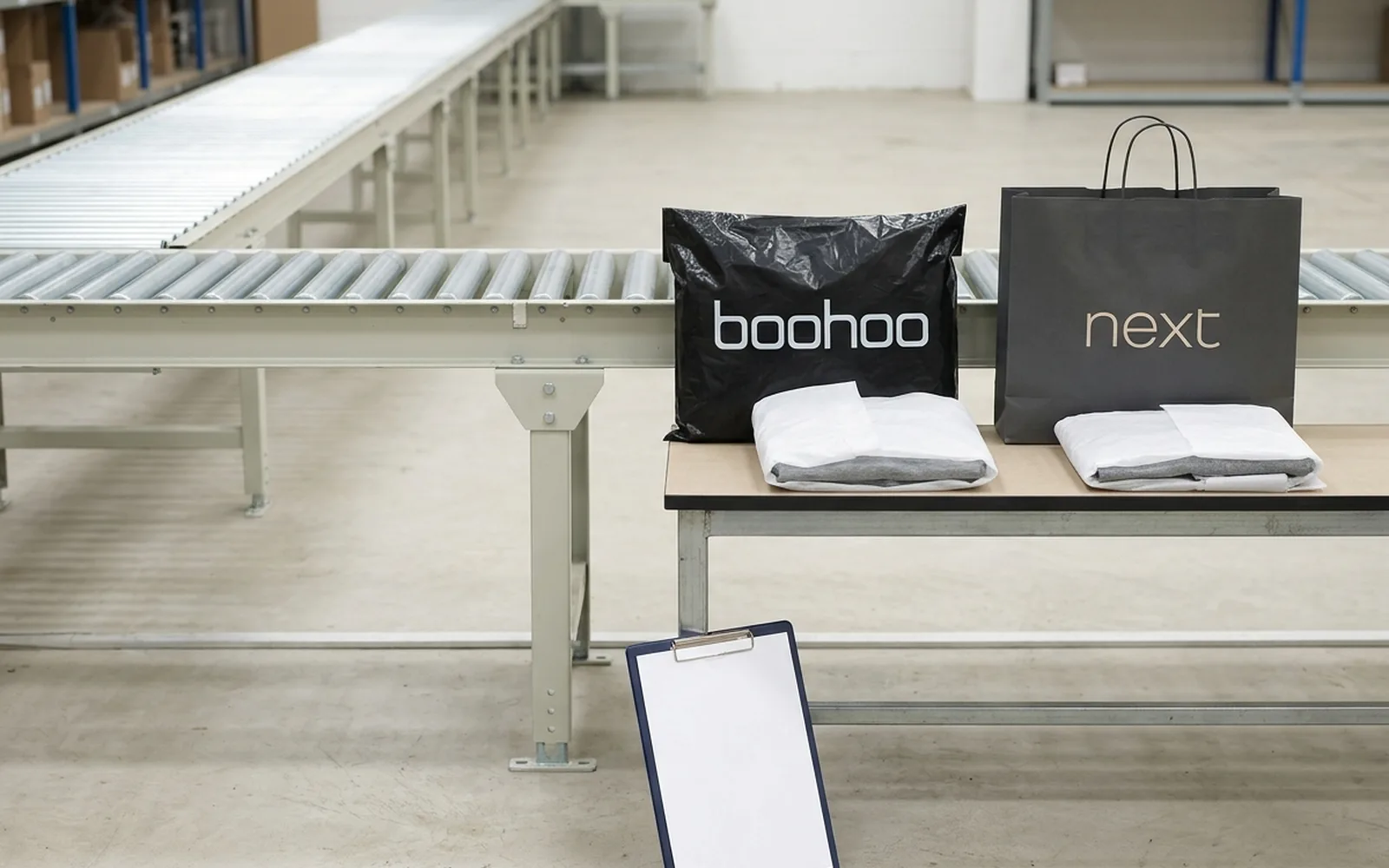
This is a Global e-Business assignment comparing the customer journeys of two UK fashion retailers, Boohoo and Next, written for the module of that name at the University of Hertfordshire. The method is a walkthrough: the writer shopped both sites as an ordinary buyer and captured each stage, from a Google search through the landing page, product listing, checkout and order tracking. The site evidence was collected in November 2021, so the screenshots show the sites as they were then; a 2026 update on both companies has been added below. One thing the update shows, and which a marker will expect an evaluation to say: journey quality is one input to commercial performance, not a proxy for it.
For the service page, see MBA and management assignment help. More business assignment samples are in the archive, and our University of Hertfordshire assignment help page lists the other Hertfordshire coursework we have published.
Assignment Question
Analyse and compare the customer journeys of Boohoo and Next across all stages of the e-business process. Propose an innovative e-business model to enhance user experience and business outcomes.
Customer Journey Analysis of Boohoo and Next
Introduction
This report evaluates the customer journey of two similar retail e-businesses specialising in clothing and apparel. It sets out the features and processes of each site and how those affect what the customer experiences. The two e-businesses chosen for this report are Boohoo and Next. Both sell fashion, cosmetics and apparel, and they were chosen because they sit in the same category while differing sharply on the pre-purchase, purchase and post-purchase stages. The new business proposed at the end is an e-commerce platform named 'Pumky' in the same category. The report works through awareness, then search and consideration, then purchase and post-purchase, and closes with the comparison, the proposal and a conclusion.
How Do the Customer Journeys of Boohoo and Next Compare?
Boohoo leads at discovery and checkout, Next at product information. Boohoo appeared more often in paid and organic search, opened on an offer, showed five products per row, allowed guest checkout and listed more ways to pay. Next showed star ratings inside its listings, but required an account and offered no self-service order tracking.
Boohoo against Next, stage by stage, November 2021
| Point of comparison | Boohoo | Next |
|---|---|---|
| Search visibility | Boohoo Several first-page results, paid and organic | Next One first-page result for the same query |
| Landing page message | Boohoo The current offer or sale | Next Order now for delivery before Christmas; no discount |
| Product listing | Boohoo Five products per row, no ratings | Next Four per row, star ratings shown |
| Checkout | Boohoo Guest checkout allowed | Next Account required |
| Payment options | Boohoo PayPal, Apple Pay, Klarna, Clearpay, Zip | Next Store account, cards, bank transfer, PayPal |
| Order tracking | Boohoo Self-service tracking after login | Next Estimated date only; paid customer services line |
The framework is the four-stage model the module set: awareness, search and consideration, purchase, and post-purchase. Mangiaracina, Brugnoli and Perego (2009) offer a finer map of the purchase half, five stages from site entering and landing, through catalogue browsing and product discovery, product selection and personalisation, and shopping cart management, to the checkout process, each scored so that two sites can be compared at the same point rather than in general. This report keeps the module's four blocks and judges each on what the site does for the shopper standing in it. The value of working that way is that it separates a site that is good at being found from a site that is good at being bought from, which are different problems with different fixes.
To evaluate the two sites, the study began by searching for fashion and clothing products on search engines. Since an ordinary buyer starts at a search engine such as Google or Bing, that is where the walkthrough started. The idea was to take the position of an ordinary buyer and repeat the steps that buyer would take towards an online purchase on either site.
At the need and search stage, Boohoo returned better results for almost every query, and it held promoted placements as well, which indicates spending on paid search alongside its organic visibility.
Next, by contrast, had only one entry on the first page of Google for the same query.
Boohoo also showed more results than Next for related keywords. We tested this further with 'buy skirt online', 'buy men's boots' and 'formal shoes under 200 pounds', and the pattern held every time. On this evidence the awareness Boohoo had built through search optimisation was well ahead of Next's.
Both retailers use digital advertising and campaigns to build awareness. Boohoo has also used reality-television personalities as brand ambassadors, while Next leans more on digital influencers and online celebrities.
The landing pages differ in several ways. The first thing Boohoo shows is the current offer or sale. Messages of that kind, promotional coupons, '80% off', limited-period offers and 'shop new', are used to raise the response to a call to action and to speed up the decision to buy (Todor, 2016).
On the Next site the message was to order now to receive delivery before Christmas. There was no mention of a discount or a promotional offer.
The product discovery pages differed as sharply as the landing pages. Boohoo used the full width of the screen and fitted five clear results into a row.
On the Next site only four results were visible in a row, and the row looked more crowded.
What Next did better was show user ratings on the product discovery page itself, which helps a shopper judge between products without opening each one (Flanagin et al., 2011). That was missing from the Boohoo listings.
At the purchase stage the sharpest difference was checkout. Boohoo let the shopper continue as a guest; Next had no such option (figures 1 and 2).
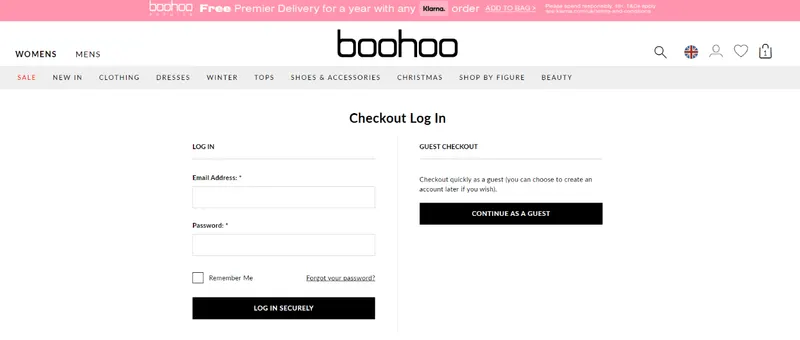
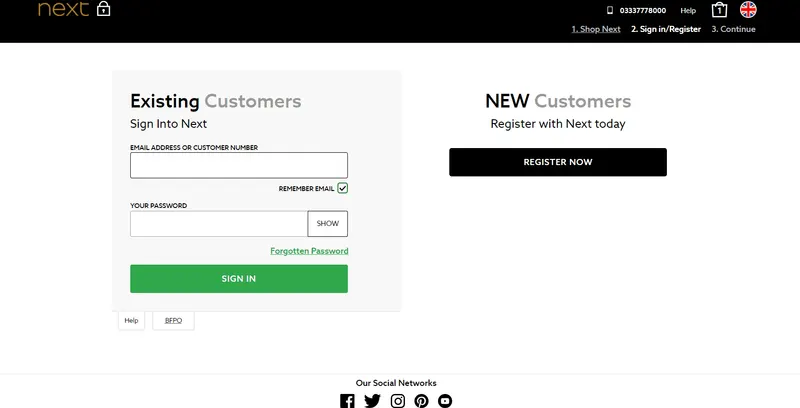
Because information on the online path to purchase is communicated visually, eye-tracking studies use where shoppers look to test how far an e-commerce site supports a smooth transaction (Wong, Bartels and Chrobot, 2014). On this walkthrough Boohoo's interface was the easier of the two to use: wider listings, clearer images and fewer steps between a product and the basket. That is the writer's judgement from the stages captured here, not a published finding about either retailer.
Payment options were the other clear difference. Boohoo listed several ways to pay, including PayPal, Apple Pay, Klarna, Clearpay and Zip, while Next was limited to its own store account, credit and debit cards, bank transfer and PayPal.
The final stage of the walkthrough was the post-purchase process. Both sites confirm the order by notification once it is placed. On Boohoo the shopper can log in and track the order at any point. On Next the shopper gets an estimated date and no tracking on the site; a customer services number is given instead, on a paid line, to ask about the status of an order. Charging for secondary services after the order, whether shipping, tracking, cancellation or a refund, works against the experience the site has just built.
Boohoo also emails customers who have opted into its newsletter. An account holder is asked at sign-up whether they want to join it. Next asks the same permission but does not make the same use of email to bring previous customers back with new products and offers. Email is the cheapest route an online retailer has back to a previous customer, and Next was not using it.
Limitations of the Walkthrough
Three gaps in the method should be stated plainly. The walkthrough covered the desktop sites rather than either retailer's app, where a large share of fashion shopping now happens. It stopped at order confirmation, so returns, refunds and customer service after a problem were never tested, and those stages decide whether a shopper comes back. And it ran in the weeks before Christmas, when both retailers were promoting seasonally, so the landing pages described here are not what the same sites show in February.
The biggest limitation of these findings is that they rest on a limited set of products and categories. Interface and design preference also vary between individuals: a consensus view can be reported, but it will not describe every shopper. Trust, brand loyalty and social awareness pull people back to a particular site for reasons that sit outside the website itself, and those are managed by the business rather than designed into a page.
What Would a Better E-Business Model Look Like?
The proposal, called Pumky, takes Boohoo's interface, guest checkout and payment range and adds the one thing Next does better: ratings on the listing page. Live order tracking, automated confirmation emails and a controlled newsletter frequency complete it. The argument is that no single stage decides a journey; the weakest one does.
The proposed e-business is named 'Pumky' for an audience of younger and middle-aged shoppers: a short name is easier to remember and easier to build awareness around. The platform would use search optimisation and paid search to put products in front of users by category, and third-party placements such as blog advertising where the readership matches the target group, bought on a pay-per-click basis so the spend follows the traffic. Alongside the digital channels it would take part in events and social causes, which builds the brand in places search cannot reach.
The site would take its layout from Boohoo: easy to navigate, scroll, search and compare. The one feature it would take from Next is product ratings on the discovery page, because that is what lets a shopper choose without opening five tabs. At the purchase stage it would allow fast guest checkout, but only where payment is made in full, which keeps the convenience without opening the policy to misuse. It would accept as many payment methods as Boohoo does, because a shopper whose preferred method is missing at the last step has a reason to leave. Delivery would go through established carriers. Customer experience is one of the factors that decides whether an online shopper returns (Tarhini et al., 2018), so the platform should spend its limited resources on service quality rather than on more promotion.
For the post-purchase stage the platform would send automated confirmation emails and offer live order tracking, as Boohoo does, so a shopper can check the status without asking anyone. An interactive voice response line would cover customers who would rather telephone, and the call centre could be run from a country with a large English-speaking workforce, such as India, to keep the cost down. Newsletter subscribers would be emailed about offers and promotions, but on a controlled frequency, because too many emails produce unsubscribes: one email every three weeks for ordinary buyers and one every ten days for frequent buyers, adjusted on what the open rates show. Subscribers would also get a discount code after a purchase, which gives a reason to come back and is the cheapest retention the platform has.
What Has Changed at Boohoo and Next Since This Study?
Boohoo's parent has renamed itself Debenhams Group, reported revenue down 12 per cent to £790.3m for the year to February 2025 and moved to a marketplace model (Boohoo Group, 2025). Next reported total group sales of £7,004m for the year to January 2026, up 10.8 per cent, with profit before tax up 14.5 per cent (NEXT plc, 2026). The better journey did not win.
NEXT and Debenhams Group on their latest full-year results
| Point of comparison | NEXT plc | Debenhams Group |
|---|---|---|
| Period reported | NEXT plc 52 weeks to January 2026 | Debenhams Group Year to 28 February 2025 |
| Revenue | NEXT plc Total group sales £7,004m, up 10.8% | Debenhams Group Revenue from continuing operations £790.3m, down 12% |
| Profit measure reported | NEXT plc Profit before tax £1,158m, up 14.5% | Debenhams Group Adjusted EBITDA £41.6m |
| Online growth noted | NEXT plc Online sales up 28% over two years against a 10% expectation | Debenhams Group boohoo marketplace launched with over 1,000 brands; PLT and boohooMAN marketplaces live |
| Where the money goes | NEXT plc Warehouse investment brought forward | Debenhams Group A capital-lite, stock-lite marketplace model |
Both companies moved, and in opposite directions. Boohoo Group renamed itself Debenhams Group, telling shareholders it would "continue forward as Debenhams Group under new leadership, a new strategy, and a new direction". It reported revenue from continuing operations down 12 per cent to £790.3m, and adjusted EBITDA of £41.6m for the year to 28 February 2025, and put what it calls a "capital-lite, stock-lite, cost-lite, cash-generative marketplace model" at the centre of its strategy (Boohoo Group, 2025). The same announcement reports the model moving across the group's own labels: "In FY25, we launched boohoo's marketplace with over 1,000 brands. PLT and boohooMAN marketplaces are also now live", and for Karen Millen, "we will accelerate growth with our broader marketplace model, building on the introduction of pre-loved luxury to diversify its product offering". The document is filed by "boohoo group plc (the 'Company' or the 'Group' or 'Debenhams Group')", so the legal entity and the trading name sit side by side in the same report, which is worth a sentence in any assignment that cites it.
Next went the other way and grew on its own stock. For the 52 weeks to January 2026 it reported total group sales of £7,004m, up 10.8 per cent, and group profit before tax of £1,158m, up 14.5 per cent. It also noted that online sales grew 28 per cent over the previous two years against an expectation of 10 per cent, and is bringing warehouse capital expenditure forward as a result (NEXT plc, 2026).
That matters for the argument above. The 2021 walkthrough concluded that Boohoo offered the better customer journey. Five years on, the company that scored worse on journey design is the larger and more profitable of the two, and the company that scored better has moved to a commission model where third-party sellers own much of the fulfilment the walkthrough was judging.
Conclusion
This report evaluated two e-commerce sites by working through the stages of the customer journey in turn. Neither site was better at everything: Boohoo was ahead on search visibility, listing design, checkout and order tracking, and Next was ahead on product ratings. On the balance of those stages Boohoo gave the better journey in November 2021. The proposed platform is closest to Boohoo, with the ratings feature Next has and the tracking and email discipline neither had fully. The gap Boohoo could close at the least cost is the one Next already fills: show the ratings where the shopper is choosing.
Need a similar e-business or customer journey analysis? Message us on WhatsApp with the brief, the module name and your deadline.
Sources
- Boohoo Group plc, 2025. Final results for the year ended 28 February 2025. https://www.investegate.co.uk/announcement/rns/boohoo-group--debs/final-results/9073782
- Flanagin, A.J., Metzger, M.J., Pure, R. and Markov, A., 2011, January. User-generated ratings and the evaluation of credibility and product quality in e-commerce transactions. In 2011 44th Hawaii International Conference on System Sciences (pp. 1-10). IEEE.
- Mangiaracina, R., Brugnoli, G. and Perego, A., 2009. The eCommerce customer journey: a model to assess and compare the user experience of the eCommerce websites. Journal of Internet Banking and Commerce, 14(3), pp.1-11. https://www.icommercecentral.com/open-access/the-ecommerce-customer-journey-a-model-to-assess-and-compare-the-user-experience-of-the-ecommerce-websites.pdf
- NEXT plc, 2026. Results for the year ending January 2026. https://www.nextplc.co.uk/~/media/Files/N/next-plc-v4/documents/2026/year-end-results-january2026.pdf
- Tarhini, A., Alalwan, A.A., Al-Qirim, N. and Algharabat, R., 2018. An analysis of the factors influencing the adoption of online shopping. International Journal of Technology Diffusion (IJTD), 9(3), pp.68-87.
- Todor, R.D., 2016. Blending traditional and digital marketing. Bulletin of the Transilvania University of Brasov. Economic Sciences. Series V, 9(1), pp.51-56.
- Wong, W., Bartels, M. and Chrobot, N., 2014, June. Practical eye tracking of the ecommerce website user experience. In International Conference on Universal Access in Human-Computer Interaction (pp. 109-118). Springer, Cham.
Related samples: marketing strategy of H&M, global marketing strategy, digital marketing strategy for a food delivery app, and University of Hertfordshire assignment help.
Frequently Asked Questions
What is a customer journey analysis in e-business?
A stage-by-stage walk through a real purchase as a customer would experience it: awareness, search and consideration, purchase, and post-purchase. You record what the site does at each stage, compare it with a rival, then judge which design serves the shopper better and why. Screenshots are the evidence.
How do the Boohoo and Next customer journeys differ?
Boohoo wins on discovery and checkout: stronger paid and organic search presence, an offer-led landing page, five products per row, guest checkout and more ways to pay, including PayPal, Klarna and Clearpay. Next wins on product ratings shown in listings, but forces account creation and gives no self-service order tracking.
What are the stages of the e-commerce customer journey?
The assignment works through four: awareness (advertising, search visibility and brand ambassadors), search and consideration (the landing page, listings, filters and ratings), purchase (checkout flow and payment options) and post-purchase (confirmation, tracking, returns and email marketing). Some briefs add advocacy as a fifth stage.
Is Boohoo still called Boohoo Group?
The group now trades as Debenhams Group. Its results for the year to 28 February 2025 were published by boohoo group plc under that name, and told shareholders the company would "continue forward as Debenhams Group under new leadership, a new strategy, and a new direction". The boohoo.com website still trades under its own name.
Which university module was this written for?
The Global e-Business module at the University of Hertfordshire. The brief asked students to analyse and compare the customer journeys of two e-businesses across all stages of the e-business process, then propose an innovative model to improve user experience and business outcomes.